

Your team attended the workshop. They nodded, took notes, and filled out the feedback form. Three weeks later, nothing has changed. That gap is where the leadership coaching vs training question begins.
Training gives people knowledge. Coaching helps them use it under real pressure, with real people. This guide shows the clear signs that your team has hit that gap, and what to do next.
Leadership Coaching vs Training: What’s the Difference?
Training teaches a skill to a group. Coaching changes how a person leads, one conversation at a time.
| Training | Leadership coaching | |
|---|---|---|
| Format | Group sessions, workshops, courses | One-on-one or small team sessions |
| Focus | Knowledge and skills | Behavior, mindset, and decisions |
| Content | Same for everyone | Built around each leader’s situation |
| Best for | Teaching new methods or tools | Changing habits and solving real problems |
| Timeline | Hours or days | Weeks or months |
Neither one replaces the other. Training works well when people lack a skill. Coaching works when people have the skill but do not use it.
For a full breakdown of how coaching works, read our pillar guide: Executive Coaching: What It Is, How It Works, and Who It’s For.
Why Training Alone Often Falls Short?
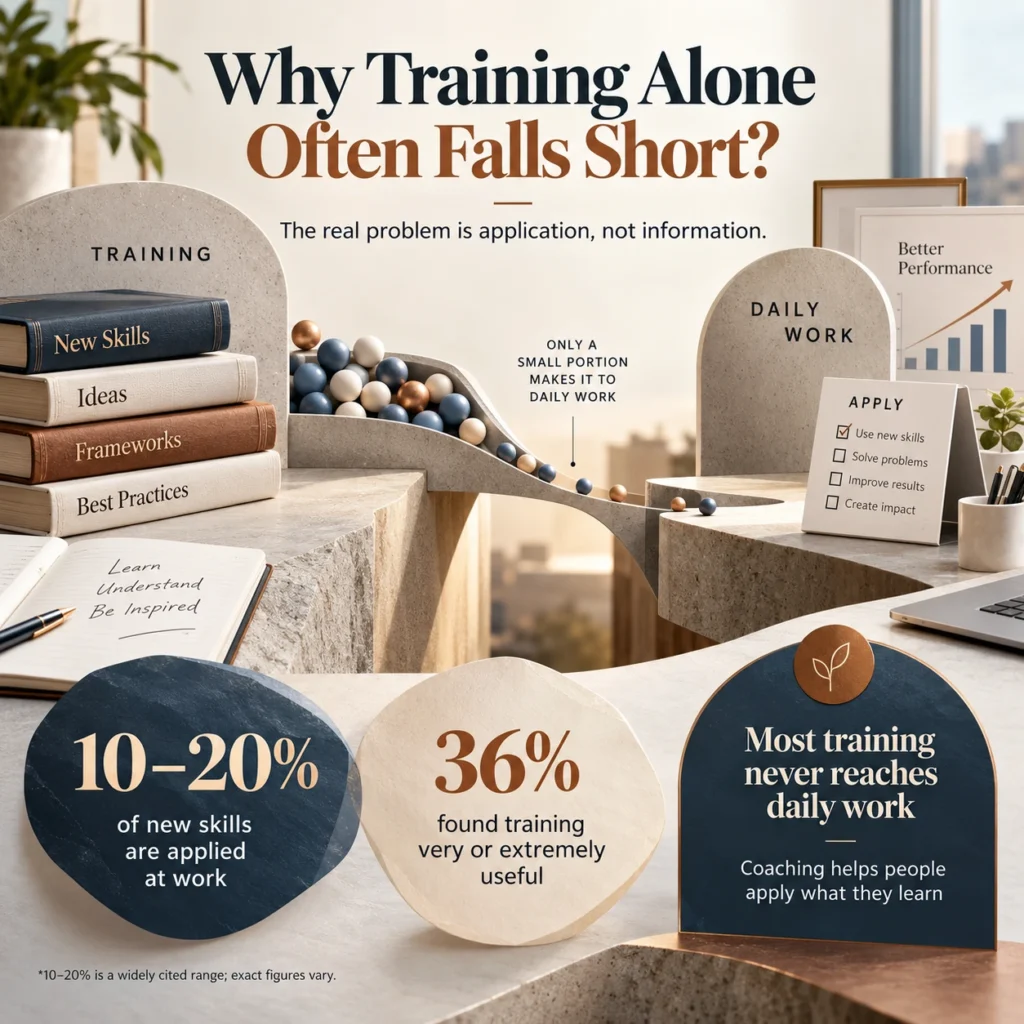
In the leadership coaching vs training debate, the real issue is application, not information.
Most training does not stick. Training Industry reports that only around 10 to 20 percent of new skills and behaviors get applied back at work.
Handle the exact numbers with care. One 2022 academic review notes that the well-known 10% figure has never been proven scientifically. The direction is still clear: a large share of training never reaches daily work.
Even when companies offer training, managers often find it weak. In a July 2026 survey of 544 US managers by Benedictine University, only 36% of those who received training called it very or extremely useful. People need support to apply what they learn. Coaching gives them that support.
8 Signs Your Team Needs Leadership Coaching
1. The Same Problems Keep Coming Back
You trained your managers on feedback last quarter. This quarter, they still avoid hard conversations. When a problem returns after training, the issue is rarely knowledge. It is habit, fear, or lack of confidence. Coaching works on those.
2. New Managers Struggle After a Promotion
Great individual contributors often become struggling managers. The same 2026 Benedictine survey found that 77% of managers moved into their first management role with no formal training. The skill they most wished they had learned was coaching and developing people (43%). The survey is directional, not statistically representative, but the pattern is clear. Personal support closes that gap better than a general seminar.
3. Your Leaders Feel Overwhelmed
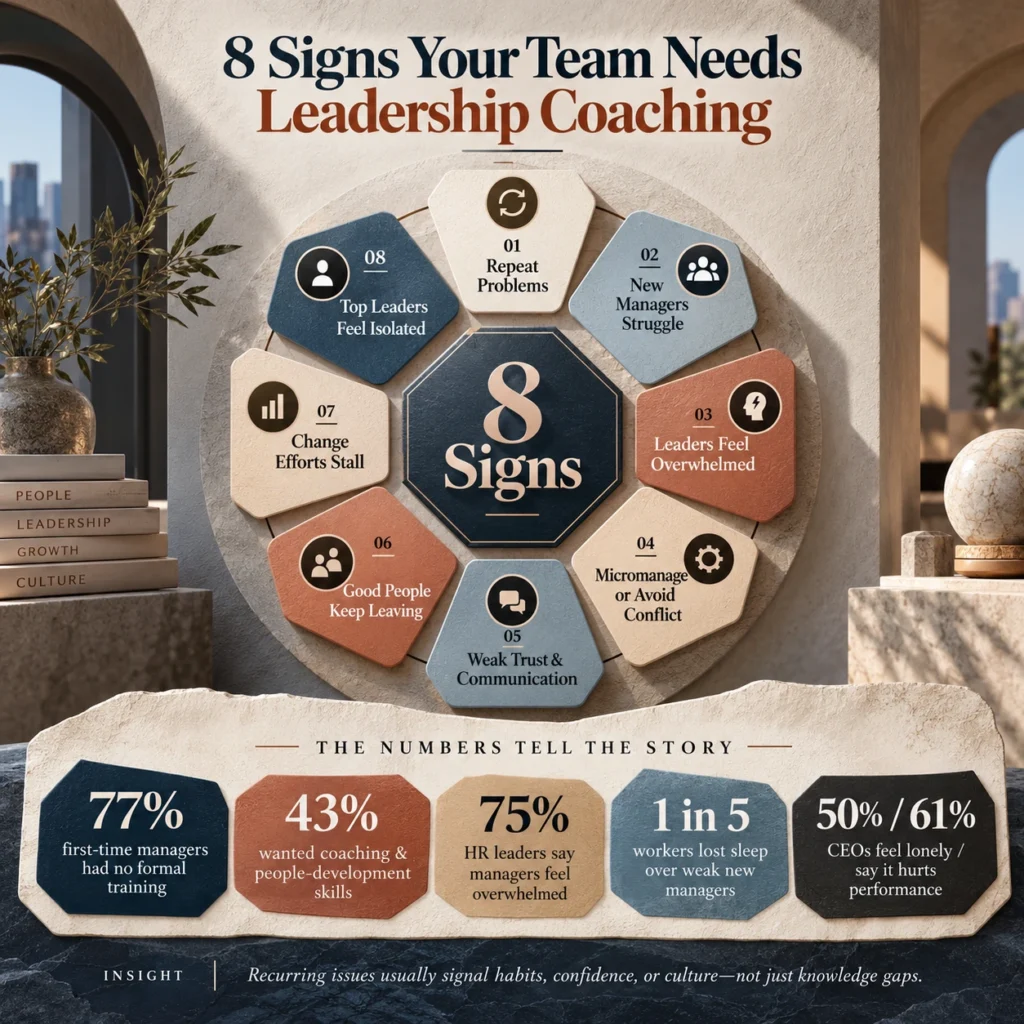
When leaders drown in tasks, they cannot learn anything new. The Gartner HR Priorities Survey, summarized by Sharpist, reports that 75% of surveyed HR leaders say their managers feel overwhelmed by expanded responsibilities. A workshop adds one more task. Coaching helps leaders sort priorities and make space to change.
4. Managers Micromanage or Avoid Conflict
These two habits look opposite, but they share a root: a lack of trust or confidence. The Benedictine survey backs this up. Managers said they took on too much work themselves (57%) and held back feedback they should have given (44%). A manager who controls every detail and a manager who dodges every hard talk both need help seeing their pattern. A coach holds up that mirror in private.
5. Team Trust and Communication Are Weak
Your team may know the rules of good communication. Yet people still hold back, stay silent in meetings, or work in silos. That points to a culture issue. Coaching, especially for the leadership team together, helps people build honest working relationships.
6. Good People Keep Leaving
People often leave bosses, not companies. If turnover clusters around certain managers, look at leadership first. A 2023 Oji Life Lab and Harris poll of more than 2,000 US workers found that one in five lost sleep over a new manager with weak leadership skills. Stress like that pushes people toward the door.
7. Change Efforts Stall
A new strategy launches. Leaders agree in the meeting. Then nothing moves. This often means leaders lack alignment or the confidence to lead people through change. Coaching helps leaders turn decisions into action.
8. Your Top Leaders Feel Isolated
Senior leaders get less honest feedback as they rise. A 2012 RHR International survey, reported by Inc., found that half of the 83 CEOs surveyed felt lonely in the role, and 61% of them believed it hurt their performance. The survey is small and old, but newer research points the same way. A 2022 Deloitte survey, covered by Fortune, found that a third of the C-suite feels lonely. No course fixes that. A trusted coach can.
When Training Is Still the Right Answer
Do not skip training when it fits. Choose training if:
- Your team lacks a specific skill, like using a new tool or process
- You need to share the same knowledge with many people fast
- The problem is clear and technical, not behavioral
The best results often come from combining both. Train the group first. Then coach leaders to apply what they learned.
How to Start: A Simple 4-Step Plan

- Name the real problem. Ask what behavior you want to change, not what topic you want to teach.
- Check what already happened. List the training your team attended and what changed afterward.
- Pick the right people. Start with the leaders whose teams feel the most strain.
- Set clear goals. Agree on how you will measure progress, such as engagement, retention, or delivery. The 2025 ICF Global Coaching Study stresses that coaching works best when organizations define and track success.
Our Leadership Coaching Services show how programs match different roles, team sizes, and goals.
Conclusion: Leadership Coaching vs Training Is Not Either/Or
If your team keeps repeating the same mistakes after a workshop, listen to that signal. Knowledge is not the missing piece. Practice, feedback, and support are. Use training to teach the skill, and use leadership coaching to make it stick.
Ready to see what that looks like for your team? Explore our Leadership Coaching Services, book a discovery call, and tell us where your team feels stuck. You will leave with a clear first step.