

First-time CEOs can expect a confidential sounding board, help shifting from running one function to running the whole company, and a steady partner through the first 12 to 18 months. Sessions usually run every two to four weeks. A good coach won’t hand you answers. They help you make better calls, faster, and spot blind spots before those blind spots cost you.
What can first-time CEOs expect from executive coaching? Less than a miracle, and a lot more than a pep talk. You get a private space to think out loud, honest feedback from someone with no stake in office politics, and a structure for the decisions that now land on your desk. Most first-time CEOs also discover something they didn’t plan for. The job changes who you talk to, who tells you the truth, and who you can safely be unsure around.
This guide covers what actually happens in a coaching engagement, what the research says about the first-time CEO experience, and where coaching stops being enough. If you want the full picture of how coaching works first, read our pillar guide, Executive Coaching: What It Is, How It Works, and Who It’s For.
Why First-Time CEOs Are Now the Norm?

Most new CEOs today have never held the job before. In a Korn Ferry analysis, 84% of the 168 CEOs appointed to S&P 500 companies in the year studied were first-time chief executives. Boards keep betting on first-timers, so the learning curve is no longer a rare problem. It’s the standard one.
That curve is mostly about behavior, not operations. The Taplow Group’s executive search work, reported by Hunt Scanlon, found that most first-time CEOs rose through functional roles. They now have to think across the whole enterprise, and nobody shares the final accountability with them. You can’t fix that with a better spreadsheet.
Expect a Sounding Board, Not an Answer Key
Your coach will ask more questions than they answer. That frustrates some new CEOs at first. They want a playbook.
But a playbook written for someone else’s company rarely fits yours. A coach helps you work out your own answer. In practice, that looks like:
- Talking through a decision before you announce it
- Rehearsing a hard conversation with a board member or a longtime friend you now manage
- Testing a reorganization idea against the objections you haven’t thought of yet
- Reviewing what happened after a rough week, and what you’d do differently
You’ll also hear things you don’t want to hear. Many coaches gather feedback from your direct reports and board members before the work starts. That gives both of you a clearer starting point than your own read on yourself.
Expect to Talk About Loneliness

Almost every new CEO feels it, and almost none expect it. An RHR International survey found that half of CEOs report feeling lonely in the role, and 61% of them say it hurts their performance. First-time CEOs fared worse. Nearly 70% of the lonely ones said isolation damaged their work. The same research found that 72% of first-time CEOs said the job looked very different from what they expected.
The reason is simple. Your old peers now report to you, and your team filters what they tell you. Board members expect confidence. Few people around you can hear “I’m not sure” without it turning into a story.
A coach fills that gap. Nothing you say gets repeated to your board or your team. You can admit doubt, try out a half-formed idea, and say the thing you can’t say anywhere else.
Here’s a gap worth knowing about. A UK survey by consultancy CJPI found that only 12% of CEOs have a formal CEO coach, and most of those lead larger or listed companies. That’s a small, UK-focused sample from a firm that sells CEO support, so treat the number as a signal, not a verdict. Still, it suggests most CEOs go without.
Expect the Timeline to Run Longer Than 100 Days
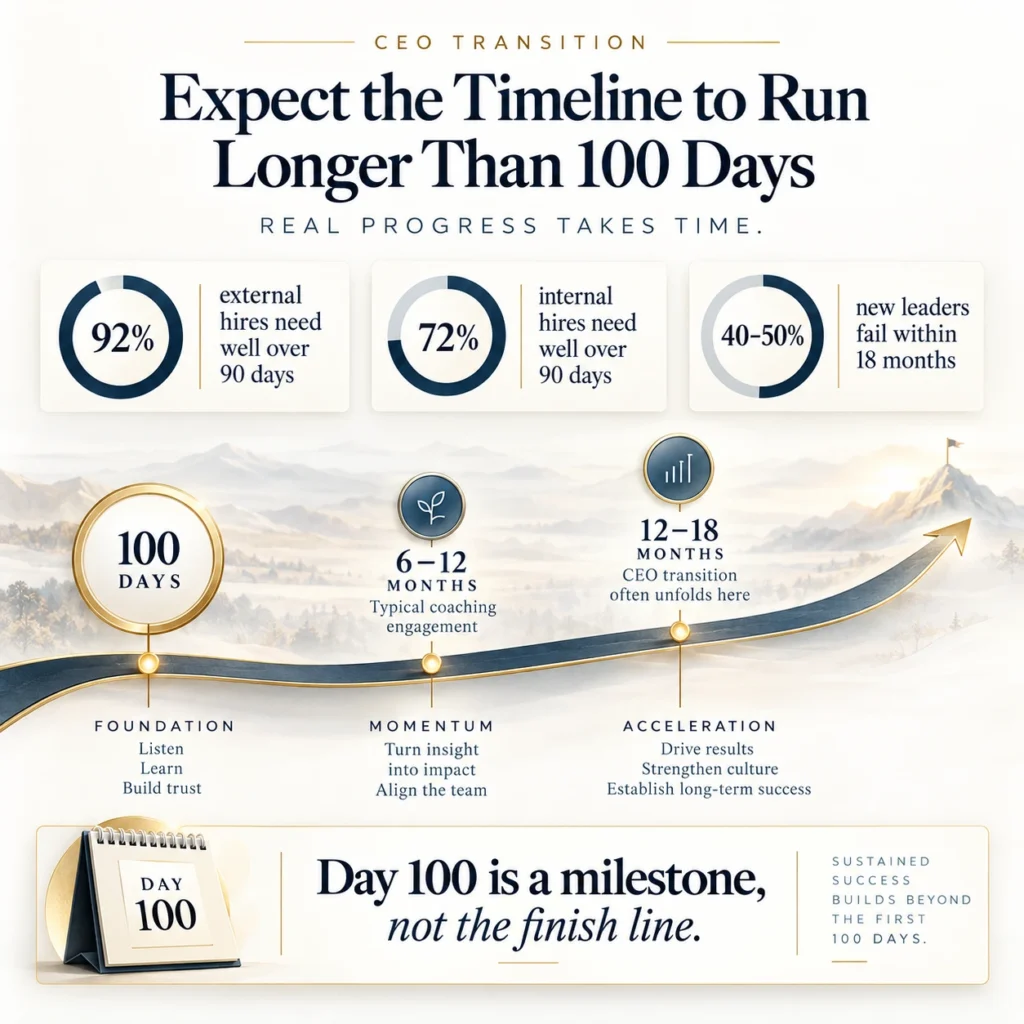
Plenty of new CEOs walk in with a 100-day plan. Plans help. But the clock is misleading.
McKinsey research found that 92% of external hires and 72% of internal hires take well over 90 days to reach full speed. The same piece reports that 40 to 50% of new leaders fail within their first 18 months. Those figures cover new leaders broadly, not only CEOs, but the pattern fits what boards see at the top.
A 2025 piece on the Harvard Law School Forum on Corporate Governance makes a similar case for CEOs. It argues that the real work of a CEO transition unfolds across the first 12 to 18 months. Cultural resistance, stakeholder misalignment, and strategy gaps often show up after day 100.
So plan for a longer engagement. Most coaching relationships run six to twelve months. For a first-time CEO, the upper end often makes sense. Our breakdown of how long executive coaching takes to show results explains what shifts in the first two months and what takes four to six.
What a First-Year Engagement Typically Looks Like?
Every engagement differs. Most follow a loose arc:
- The first month: You and your coach set two or three concrete goals, agree on how you’ll measure progress, and often collect feedback from the people around you.
- Months two to four: You work on live situations, like a restructuring decision, a tense board conversation, or a senior hire that isn’t working.
- Months five to twelve: You move from reacting to leading. You’re delegating what your old role used to hold on to, and you’re spending your time on the few things only a CEO can do.
Between sessions, you apply what came up. That part matters more than the sessions themselves.
The Topics First-Time CEOs Bring Most
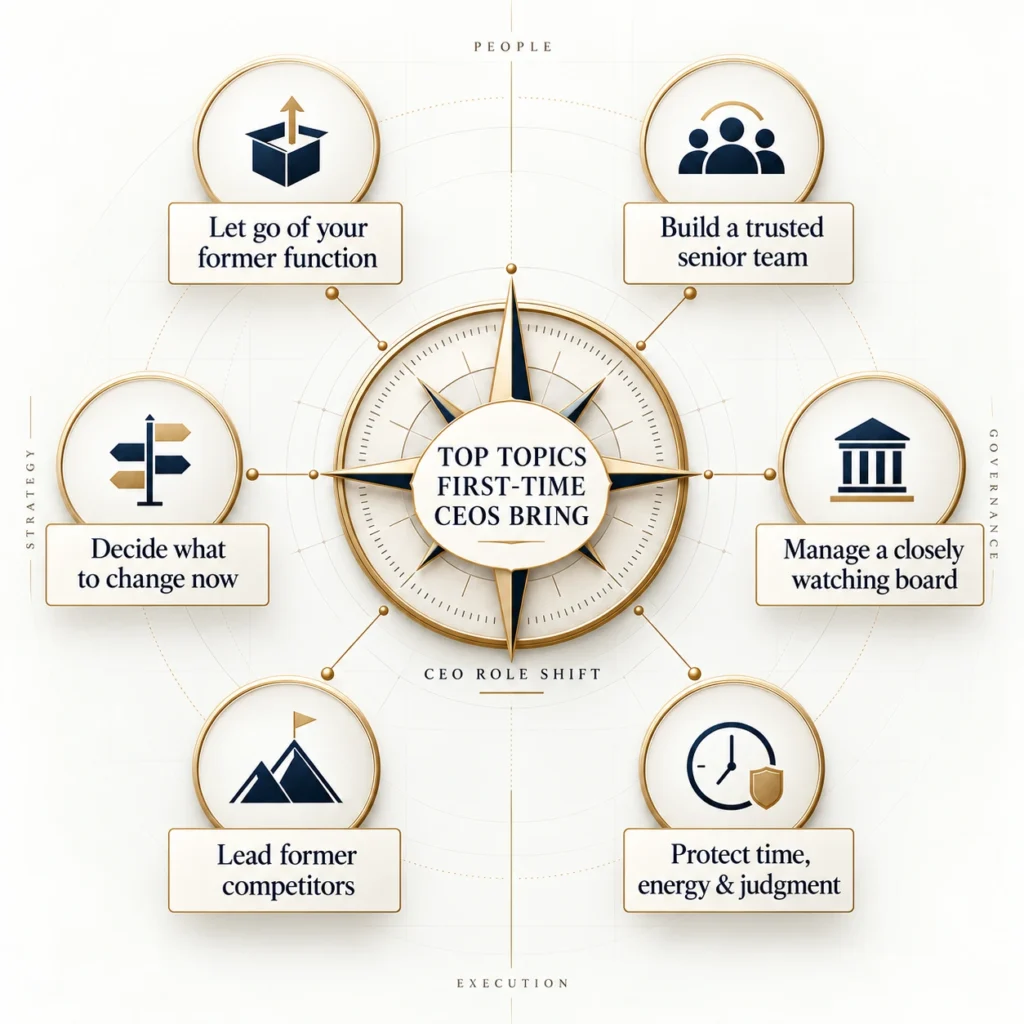
You choose the agenda, but certain themes come up again and again:
- Letting go of the function you used to run
- Building a senior team you trust, and deciding who stays
- Managing a board that watches closely
- Deciding what to change now and what to leave alone
- Leading people who once competed with you for the job
- Protecting your own time, energy, and judgment
If a few of those made you wince, you’re in good company.
What Coaching Won’t Do?
Be careful with anyone who promises that coaching alone fixes a rough transition. It doesn’t.
Korn Ferry’s analysis points out that boards often assume coaching or informal chats with the chair can cover a CEO transition. Its experts argue that first-time CEOs need a more structured transition program that covers both strategy and operations. Coaching works best as one part of that support, next to board feedback, clear first-year expectations, and a good onboarding plan.
Coaching also isn’t therapy, and it isn’t consulting. Your coach won’t diagnose anything or run your strategy review. They’ll help you think and act more clearly on your own problems.
How to Get the Most Out of It?
The leaders who see the biggest change do a few simple things:
- Bring real problems, not tidy ones
- Say what’s actually bothering you, even when it’s embarrassing
- Try the new behavior between sessions and report back honestly
- Keep a steady rhythm instead of canceling when things get busy
- Ask your coach to challenge you when you’re only getting agreement
Fit matters as much as effort. Before you commit, run a discovery call. Our guide to what happens in a free executive coaching discovery call shows what to ask and what to watch for. If you’re still comparing coaches, read how to choose the right executive coach too.
Conclusion
So, what can first-time CEOs expect from executive coaching? A private place to think, honest feedback you won’t get elsewhere, and steady support through the stretch that decides how your tenure goes. Expect questions more than answers. Early shifts show up in weeks, while deeper change takes many months. And coaching works best as one piece of a wider transition plan, not a cure-all.
The first year as CEO only happens once. You don’t have to spend it figuring everything out alone.
If you’re stepping into the top job, or you’ve been there a few months and feel the weight of it, start with a conversation. Explore our Leadership Coaching Services and book a free discovery call. It’s a short, no-obligation talk. You’ll describe where you are, ask us anything, and decide whether we’re the right fit for your first year.