
Most leaders fail not because they lack skill. They fail because no one around them is willing to say the hard thing and they don’t have the space to work through a decision before it becomes public. Executive coaching is intended to fill that gap.
Demand for it has surged fast. According to the 2025 ICF Global Coaching research, the coaching sector generated $5.34 billion globally last year, a 17% growth from the last research just two years earlier. Executive coaching alone is valued at over $100 billion when you add the larger corporate leadership development spend surrounding it.
This guide explains what executive coaching is and how the process works. It also explores who benefits most from it. Each section provides deeper insights through separate guides linked below.
What Executive Coaching Is?
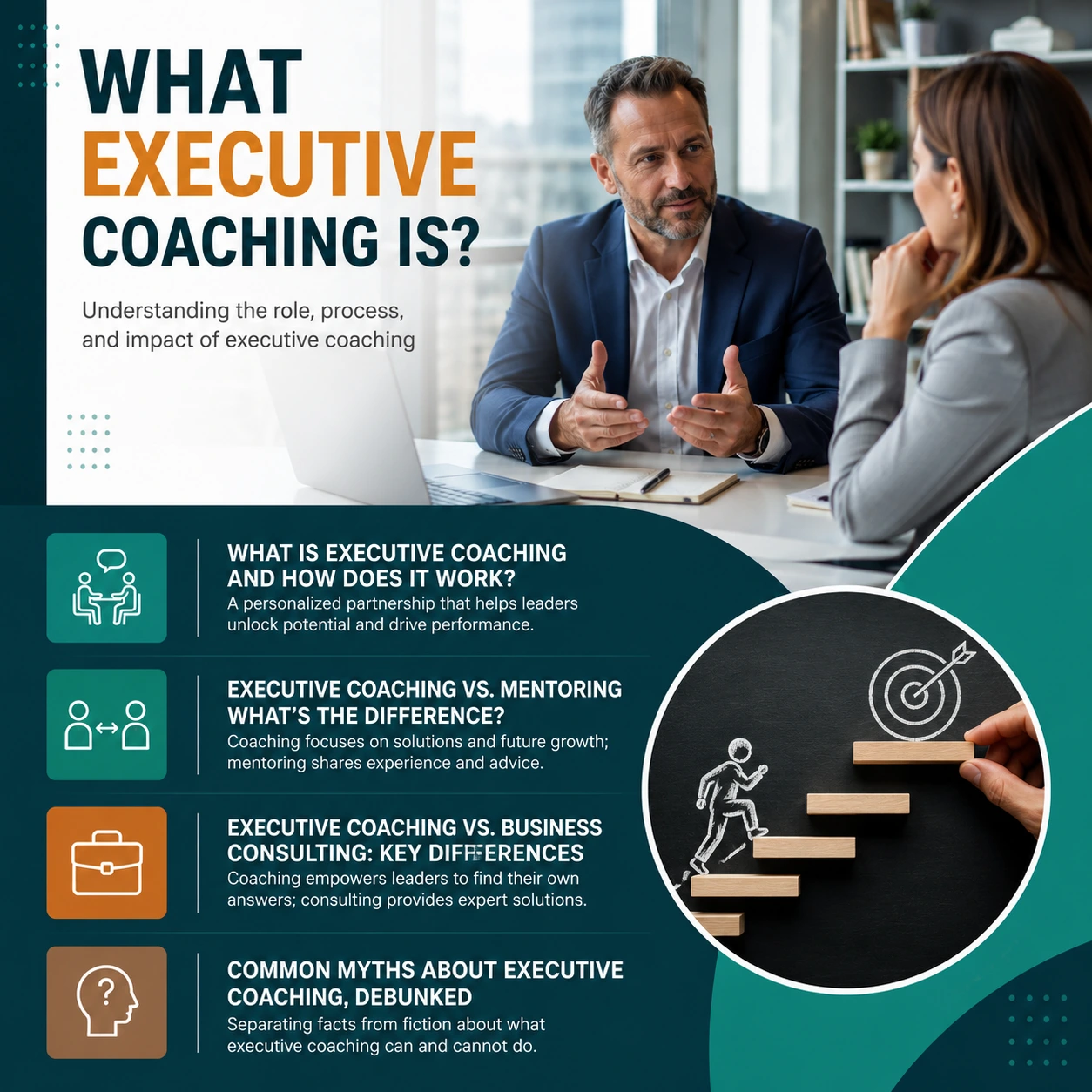
What Is Executive Coaching and How Does It Work?
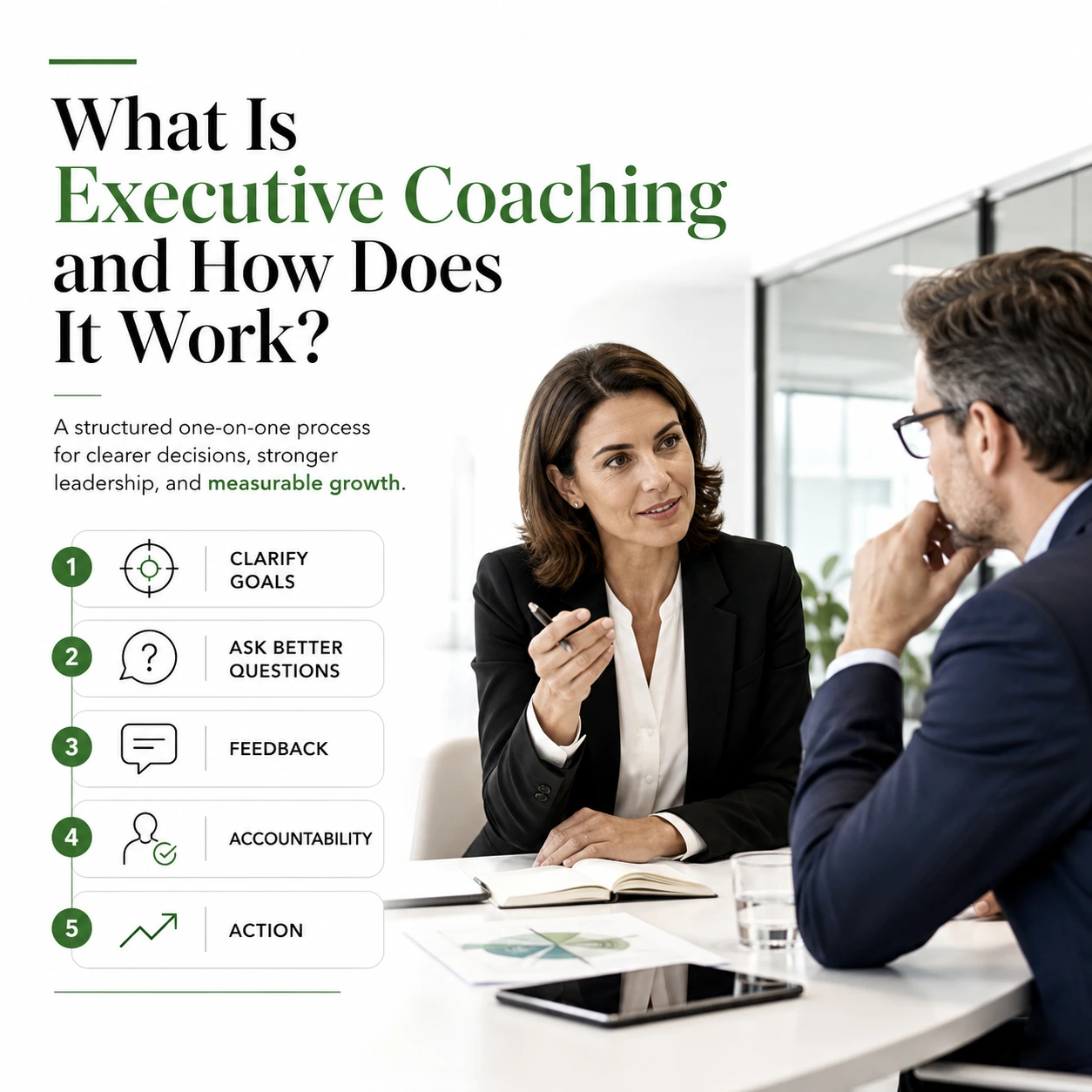
Executive coaching is a one-on-one, goal-oriented relationship where a trained coach works with a leader to improve decision-making, communication and leadership behavior in a specific role. This isn’t therapy. This isn’t one-size-fits-all business advice. A coach doesn’t provide you a strategy deck. They ask questions that make you aware of your own blind spots, and then hold you accountable to act on what you learn. If you want to learn more about What Is Executive Coaching and How Does It Work?, explore our detailed guide explaining the coaching journey step by step.
The Institute of Executive Development describes an executive coach as someone who gives structure, advice, support, and responsibility aimed to achieve demonstrable change in company behavior. Most respected instructors have at least five years of coaching experience and are credentialed by an organization such as the International Coaching Federation (ICF).
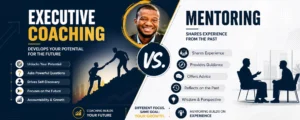
Executive Coaching vs. Mentoring: What’s the Difference?
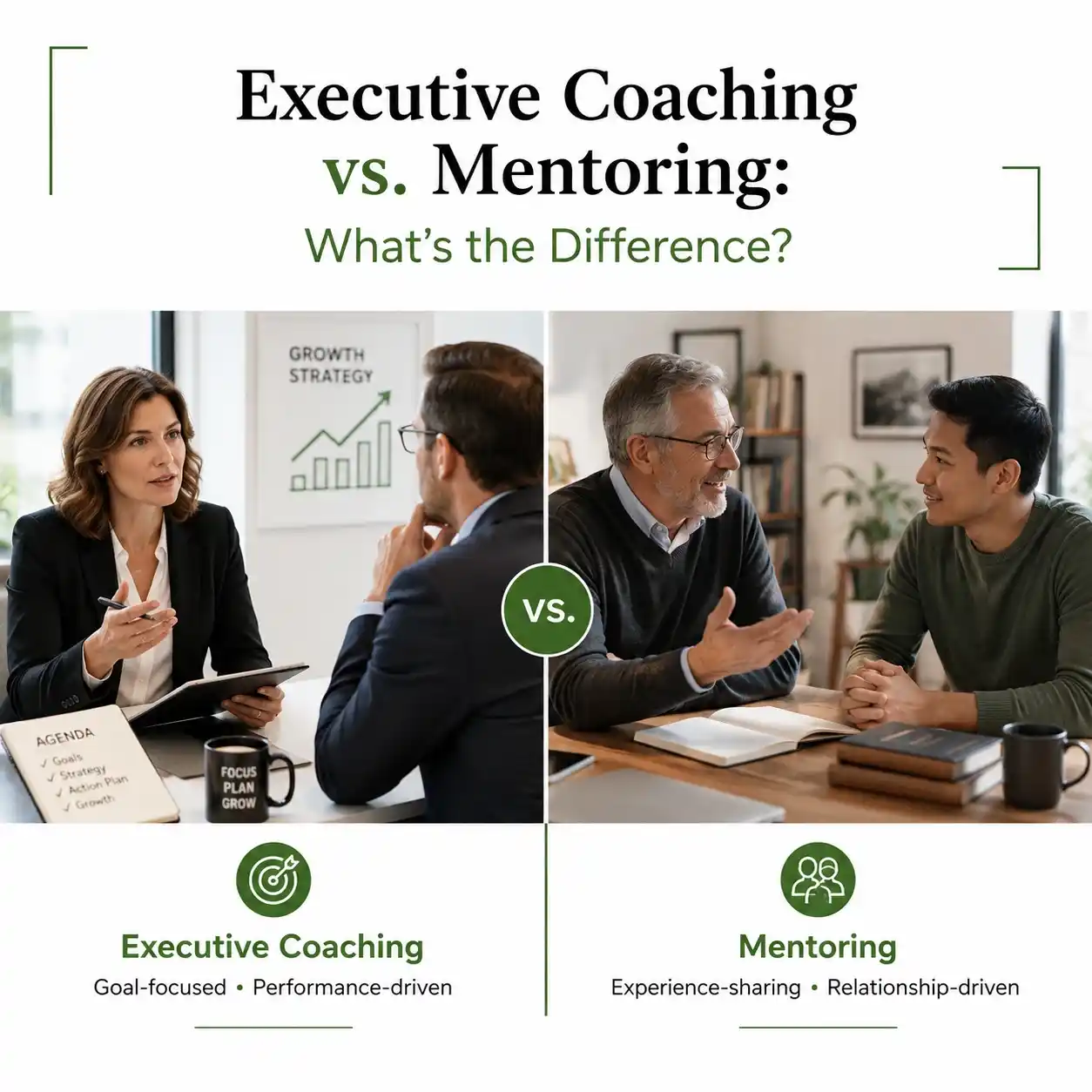
A mentor shares their personal experience and advice, often informally, usually for free, typically in the same industry or company. A coach operates differently. They don’t tell you what to do. They work with the assumption that you already have the answers, and their job is to help you find them through structured questioning, feedback, and accountability. If you’re deciding which approach is right for you, our guide to executive coaching vs. mentoring explains the key differences in more detail.
A first-time founder may need a mentor who has followed the same path. A senior leader may already understand the technical side of the job. However, they may struggle with pressure, difficult decisions, or challenging conversations. In that case, executive coaching is usually the better solution.
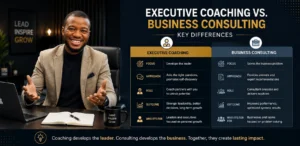
Executive Coaching vs. Business Consulting: Key Differences
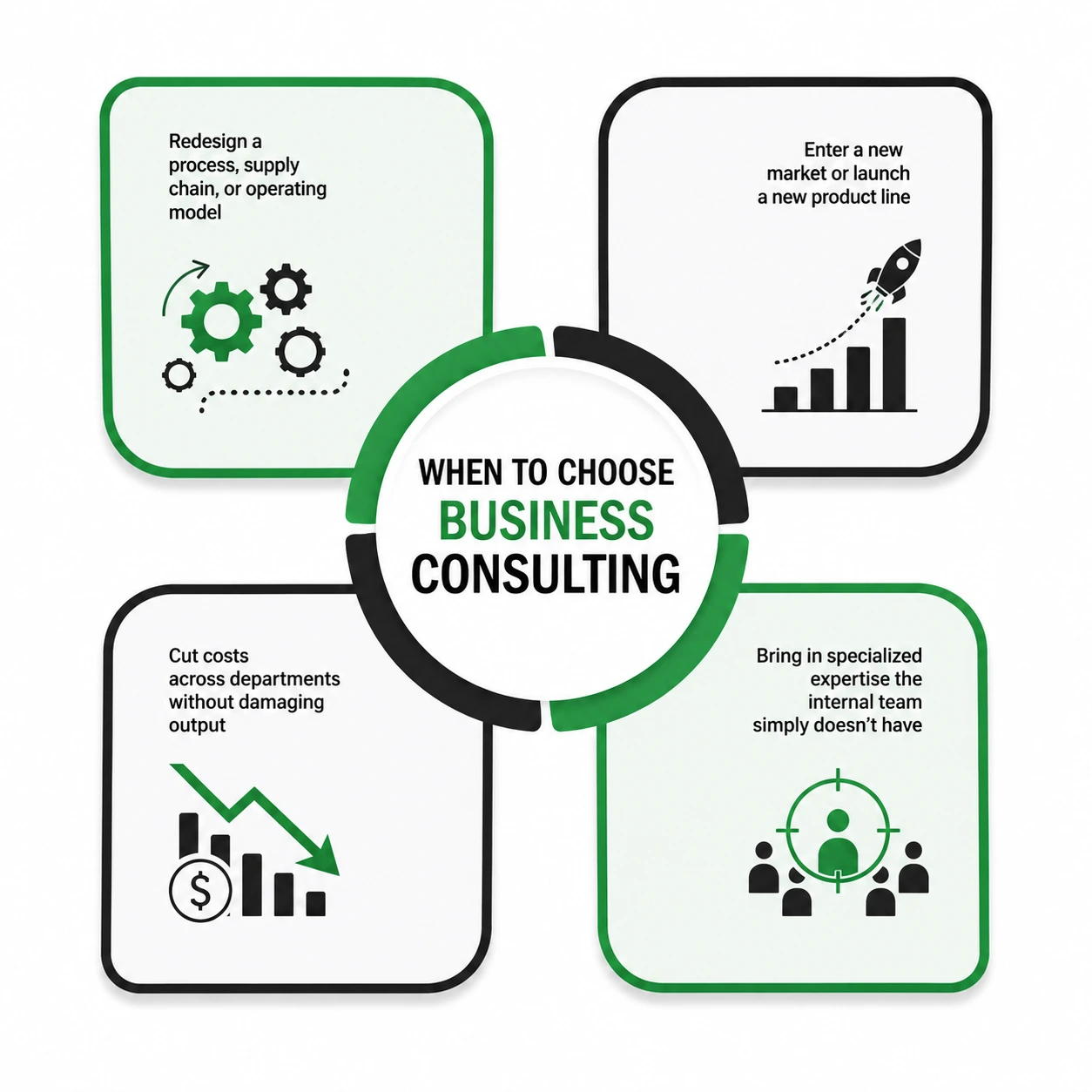
A consultant is brought in to resolve a specific business issue, and typically produces a plan, a report or a fix. They bring in outside expertise to answer “what should we do”. A coach does not give you the answers. Their duty is to make your thinking and deciding sharper so the next challenge doesn’t need an outside expert at all.
If a company is re-engineering its supply chain, it undoubtedly needs a consultant. A leader who has the appropriate strategy on paper but keeps getting stuck executing it, or keeps avoiding the unpleasant conversation with their team, needs a coach instead. For a full breakdown of when each one fits, see our detailed guide on executive coaching vs. business consulting.
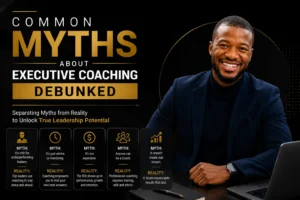
Common Myths About Executive Coaching, Debunked
The largest myth is that coaching is for struggling or ineffective executives. In fact, most of the people who get coached are doing well already. They want to help bridge the gap between good and great. One of the best-known executive coaches, Marshall Goldsmith, has observed that executives need coaching when a behavioural change, for themselves or their team, could have a major impact on the success of the organization. That’s a growth conversation, not a remedial one.
Two further myths need to be addressed. A good coach does not simply agree with everything you say; they challenge your thinking and encourage growth. Coaching is also not therapy under a different name. Therapy often explores where patterns began, while coaching focuses on improving performance and achieving goals in your current role.
How Executive Coaching Works?
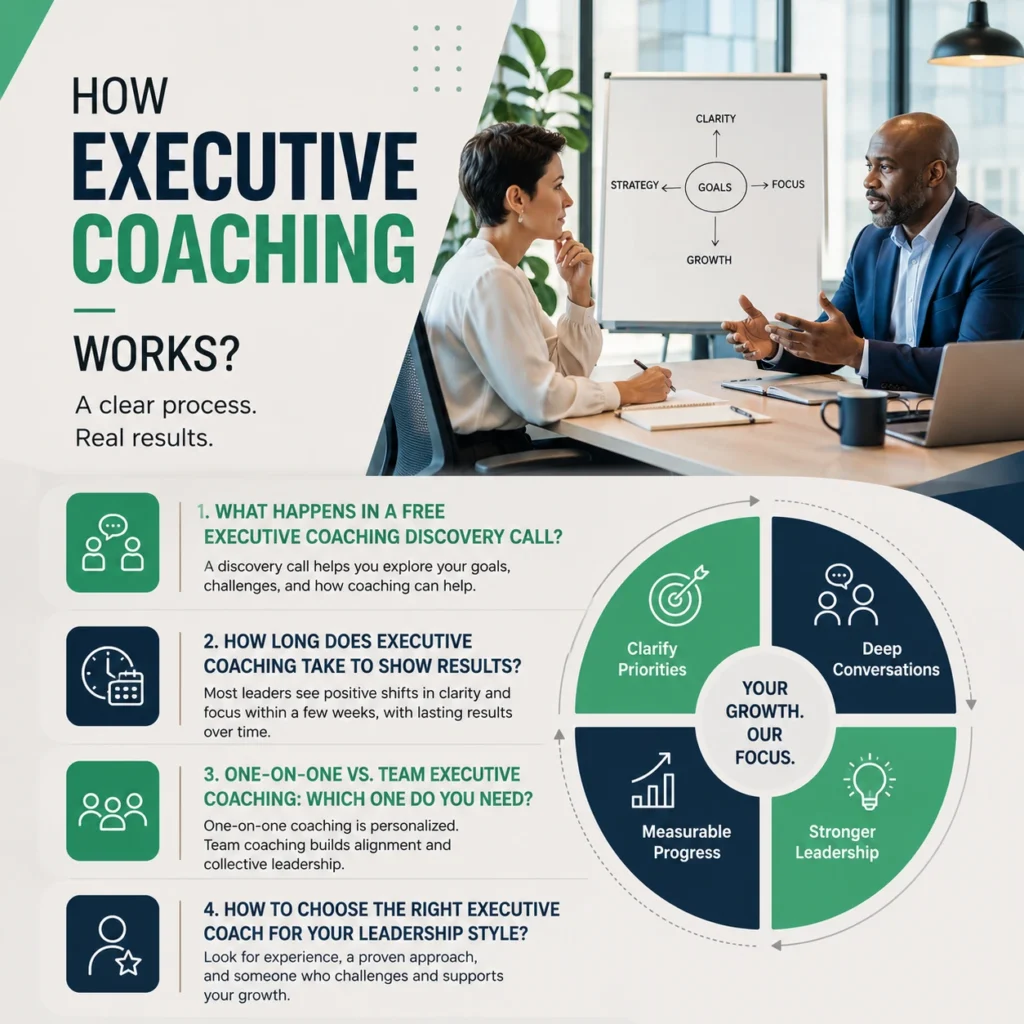
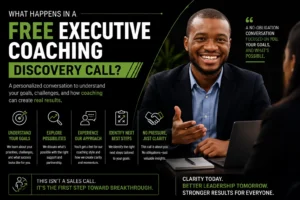
What Happens in a Free Executive Coaching Discovery Call?
Most encounters begin with a free, informal talk, around 30 to 60 minutes. This is not a sales pitch. It’s a two-way interview, the coach is trying to figure out whether they can actually assist you and you’re trying to figure out if you can trust this person enough to be honest with them.
You should expect to talk about what you are actually doing in your work today, what you have tried yourself and what a meaningful outcome will look like six months from now. There’s no obligation coming out of this call. If it’s not a fit, a competent coach would tell you directly instead of trying to seal the sale.
How Long Does Executive Coaching Take to Show Results?
Most engagements are 6 to 12 months in length, though this varies by goal. A leader facing a specific, focused difficulty such as preparation for a high-stakes negotiation could need only a few sessions. For someone trying to make a bigger transformation, like going from a controlling style of management to one based on clarity and trust, steady work over maybe a year is usually needed.
Some shifts show up fast. A leader learning to pause before reacting in a tense meeting can change within weeks. The deeper things like regaining a team’s trust take longer. Both are valid outcomes of the same process, and coaching isn’t meant to run indefinitely either way. A clear engagement has a beginning, a defined purpose, and an organic end.
One-on-One vs. Team Executive Coaching: Which One Do You Need?
Sometimes the unit that needs coaching isn’t an individual, it’s a team that isn’t communicating well or uniting on priorities. The principles of team coaching are the same as those of individual coaching: structured discourse, honest feedback and accountability, but they are applied to a group rather than a person. Team coaching is often done in addition to, or after, individual coaching sessions with the team’s leader.
One-on-one coaching makes sense when the problem is related to a certain leader’s habits or actions. Team coaching makes sense if the problem is with individuals, and not just one person.
How to Choose the Right Executive Coach for Your Leadership Style?
An ICF certificate (ACC, PCC, or MCC) provides a reasonable baseline filter but does not ensure chemistry with you. Ask how they track progress, ask about their experience with your unique problem, and pay attention to how they conduct the discovery call itself. Are they asking more questions than they’re answering? Do they push back on everything you say, or merely nod along?
Two equally trained trainers can have quite different results depending on whether you genuinely feel comfortable being direct with them. If something feels weird in the initial chat, it’s worth trying someone else before committing to months of sessions.
Who Executive Coaching Is For?
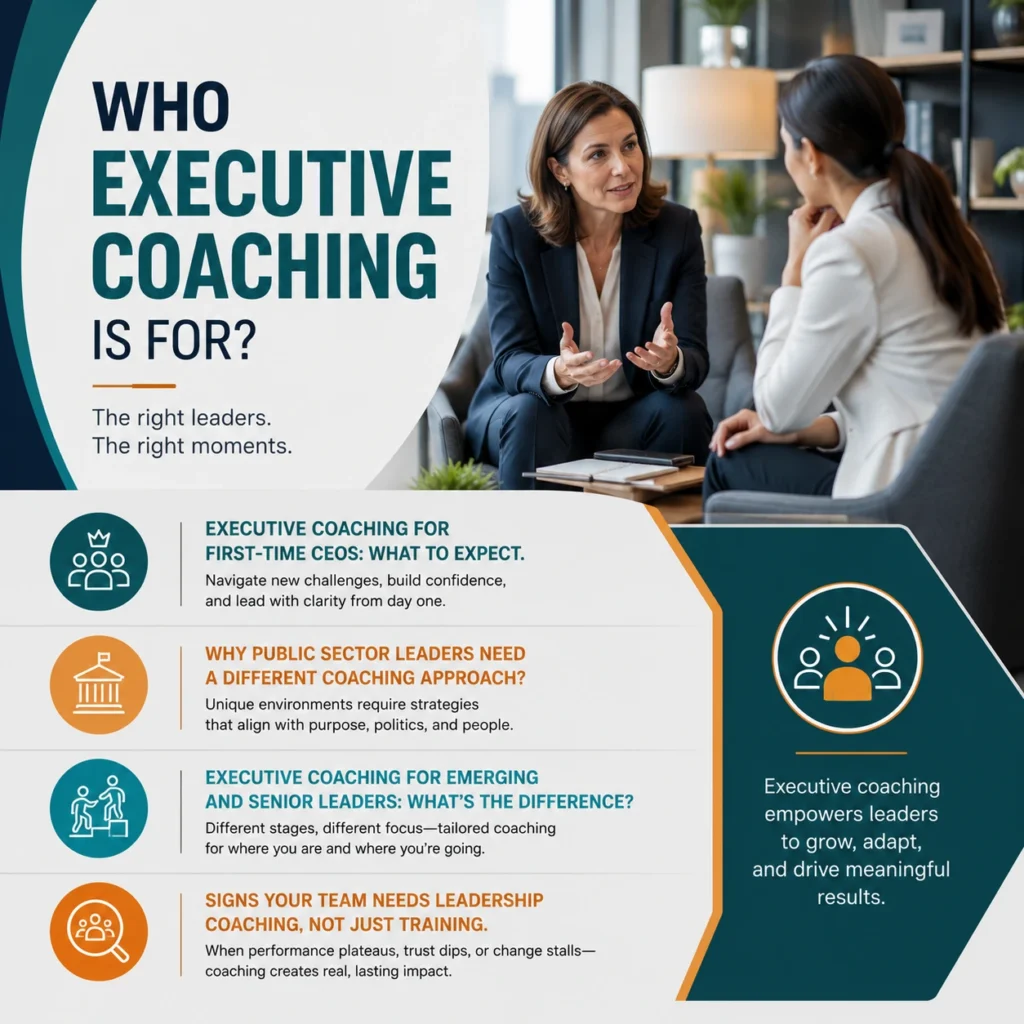
Executive Coaching for First-Time CEOs: What to Expect.
The leap from managing a function to managing an entire organization is much larger than most people appreciate. You’re suddenly responsible for decisions outside your competence, and there’s often no one internally you can be entirely truthful with. Harvard Business Publishing reports that over 70% of new CEOs suffer from true loneliness in the post and 61% feel it affects their performance directly.
Research on leadership transitions has revealed a depressing pattern. A significant percentage of newly appointed executives derail within their first 18 months on the job and it’s rarely a competency issue. It’s generally a difficulty to develop trust and alignment with the people around them.
Why Public Sector Leaders Need a Different Coaching Approach?
Public sector responsibilities have a distinct set of pressures from the private sector: political scrutiny, budget limits, and shorter decision cycles but the same stakes in terms of trust and execution. The coaching for this audience needs to be cognizant of that context, as opposed to a general corporate structure developed for a fast moving private corporation.
Executive Coaching for Emerging and Senior Leaders: What’s the Difference?
Coaching is most valuable for someone who has just been promoted to their first leadership position, to increase confidence and decision-making skills negative habits develop, rather than after. The senior leaders who are already in job tend to plateau on different things, mainly communication, delegation or managing up and coaching at that level is more about polishing a skill set that is already strong rather than mending anything faulty.
Signs Your Team Needs Leadership Coaching, Not Just Training
Training is teaching a skill to a group at one time. It doesn’t solve a team that isn’t aligned on priorities, or isn’t giving each other honest feedback, or where everyone defers every decision up to one person because no one else feels confident deciding. These are relational and trust issues, not knowledge deficits, and they usually need mentoring, not another workshop.
Does Executive Coaching Actually Work? The Data
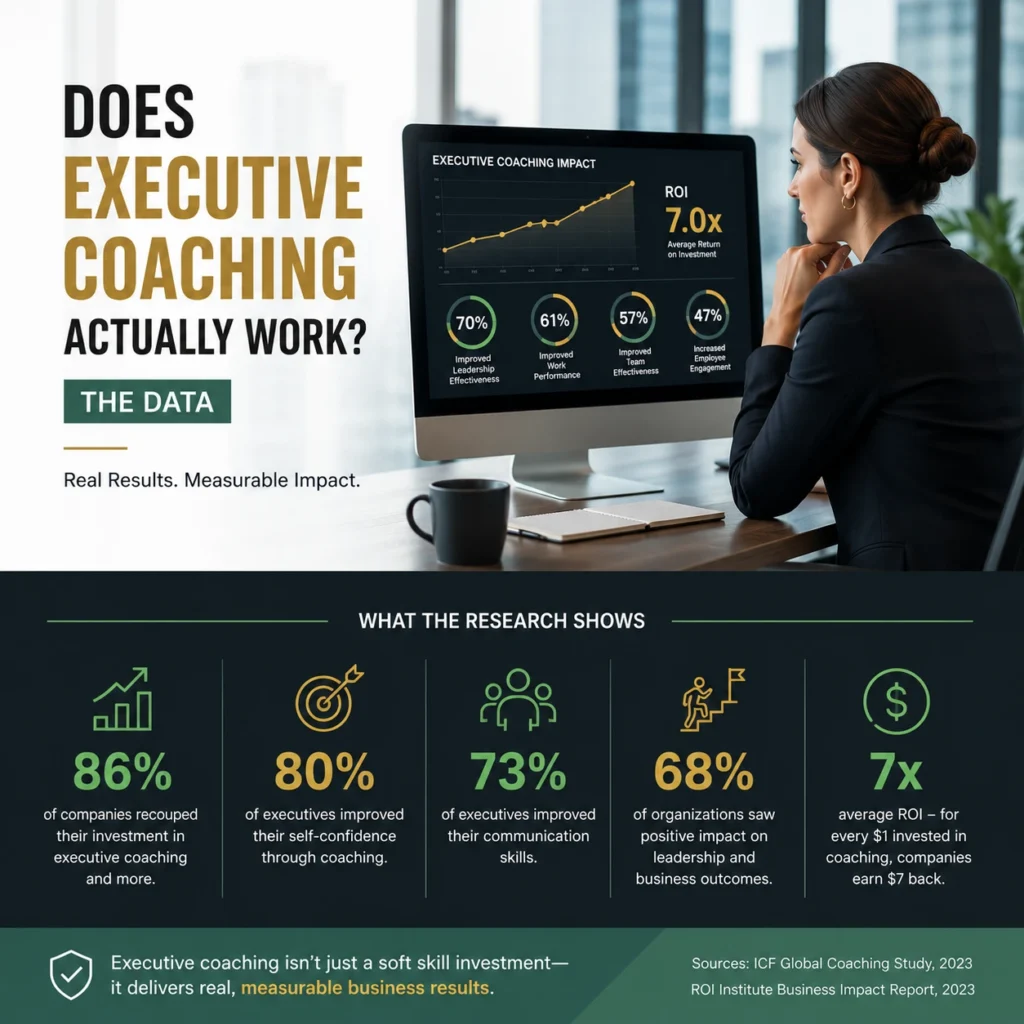
This is the issue most leaders want a response to before they’ll commit their time or budget. So it demands a straight answer, backed by numbers, not testimonials.
A widely referenced MetrixGlobal case study of a Fortune 500 telecommunications corporation reported a 529% ROI on executive coaching, rising to 788% if retention effects were taken in. That’s a single-company case study, not a universal guarantee, but it fits with broader findings. The 2025 ICF/PwC Global Coaching Client Study, which surveyed clients across 64 countries, found 87% reported a positive ROI, and 86% of organizations that tracked the numbers said coaching paid for itself, with a median return between 5x and 7x the cost.
Somewhere between 40% and 70% of Fortune 500 companies use executive coaching as part of their leadership development strategy, depending on which industry survey you check (Stratos Coaching, Hay Group estimates cited by Brainz Magazine). Eric Schmidt, Google’s former CEO, has publicly said his best advice to new CEOs is simply to get a coach.
None of this means coaching is magic. The honest caveat, worth repeating, is that most ROI surveys ask people who’ve already chosen coaching if it worked for them. That skews the numbers positive. Coaching works when the leader shows up, does the work between sessions, and tracks something specific.
Why We Coach the Way We Do?
Coaching at True Empowerment Coach begins with one core assumption, true transformation occurs when you are willing to look honestly at your condition and accept responsibility for the next step, not the complete five year plan, but the next one. We believe leadership is not about control, it’s about clarity.
Is Executive Coaching Right for You?
If you’re making decisions that affect other people’s jobs, income, or direction, and you don’t have anyone you can be fully honest with about the parts you’re unsure of, that’s usually the signal that coaching is worth exploring.
If you want to talk through whether coaching fits where you are right now, book a free discovery call. There’s no pressure, and no script, just a conversation about what clarity would actually look like for you.