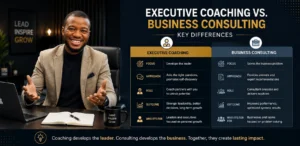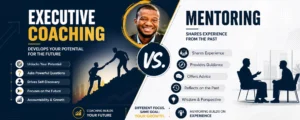

Executive Coaching Vs. Mentoring: What Leaders Do When They Want To Enhance Their Performance, Decision Making And Leadership Skills Both approaches can contribute to professional development but they work in distinct ways. Executive coaching often helps executives identify their own solutions through structured interactions, while mentoring depends more largely on the mentor’s experience, recommendations, and practical direction. This distinction can assist executives, business owners and emerging leaders to select the right form of support for their goals.
The distinction matters because leadership development is rarely about simply gaining new material. Leaders typically need to increase self-awareness, communication, decision-making, accountability, and the way they respond to challenging situations. Coaching and mentoring can satisfy these needs, but the technique, connection, and intended outcomes can differ dramatically.
Executive Coaching vs. Mentoring: The Quick Difference
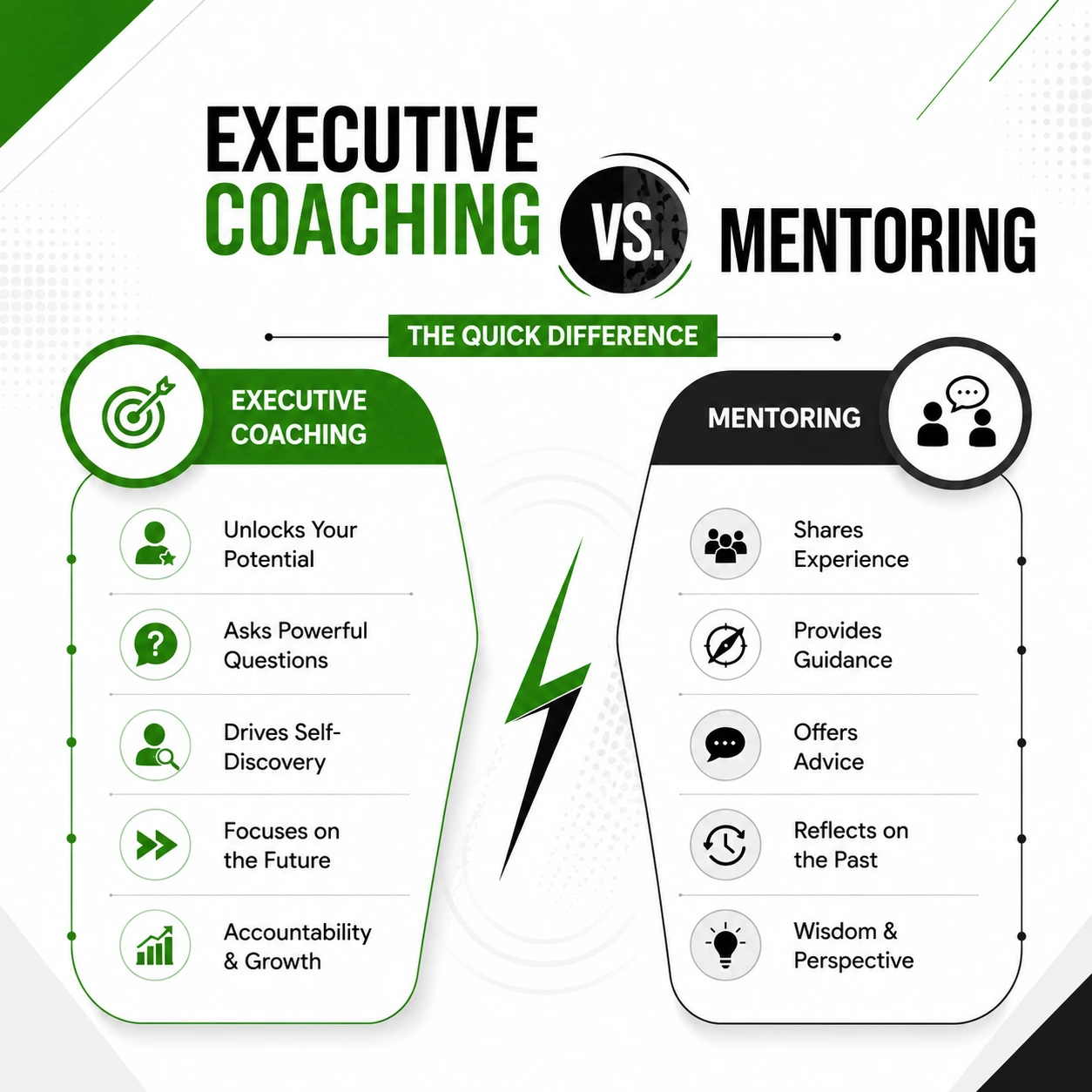
Executive Coaching vs Mentoring The easiest technique to get Executive Coaching vs Mentoring is to see where do the answers originate from.
An executive coach helps the client explore challenges, identify patterns, clarify goals, and develop their own solutions. The coach enables the process thru inquiry, active listening, reflection, feedback and accountability.
Conversely, a mentor typically has relevant personal or professional experience to help inform the connection. The mentor can share lessons, recommendations, examples, and practical advice based on situations they have already experienced.
The Association of Association Executives describes coaching as an approach centred on evoking and reframing, while mentoring generally involves advising and sharing guidance based on experience.
In simple terms:
Coaching asks, “What do you think is the right way forward?”
Mentoring asks, “Here is what I have learned from facing something similar.”
Neither approach is automatically better. The right choice depends on the leader’s situation.
What Is Executive Coaching?

Executive coaching is a formal process of professional development that is designed to support leaders in increasing their effectiveness.
The executive coach does not necessarily need to have been in the same role as the client. Rather, the coach contributes expertise in coaching approaches, behavioral development, leadership interactions, goal setting, accountability, and reflection.
-
- Leadership effectiveness
-
- Presence of an executive
-
- Strategic Options
-
- Communication abilities
-
- Delegation;
-
- Managing conflict
-
- Team leadership
-
- Self-awareness
-
- Emotional intelligence
-
- Career development
-
- Leadership transitions
-
- Responsibility
-
- Performance improvement
Executive coaching typically begins with a defined goal. The coach and client agree what the leader wants to alter or achieve and then utilize frequent sessions to review how it is going.
The Association of Association Executives says coaching relationships tend to be more formal and structured, with goals that are stated and regular meetings.
That format makes executive coaching particularly beneficial when a leader already understands the principles but wants to modify how they think, communicate, or lead.
What Is Mentoring?
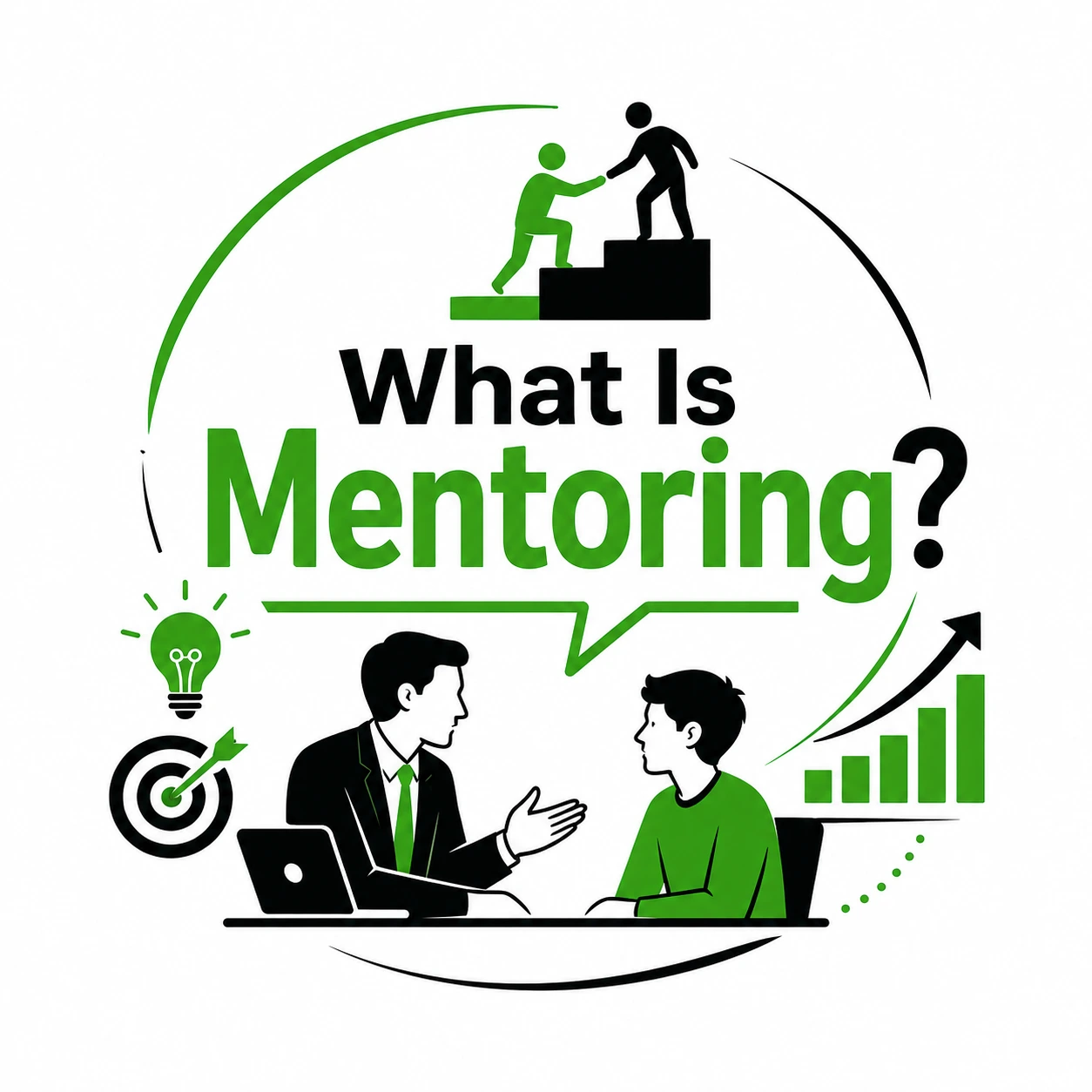
Mentoring is a developmental relationship between a more experienced individual and a learner who wants to learn and grow.
A mentor might have experience in the same area;
-
- Industry
-
- Profession
-
- Organization
-
- Leadership position
-
- Business environment
-
- Career path
Because mentors draw from personal experience, they can provide practical context that a coach may not have.
An experienced CEO might mentor a new leader by talking about how they handled board meetings, reorganizing a company, tough employes, succession planning, or big business decisions.
Mentoring can also offer access to professional networks and institutional knowledge.
A good real world example is provided by Google. Its employee-to-employee learning program, known as Googler-to-Googler or “g2g,” has involved more than 6,000 employees who volunteer to teach, mentor, and share knowledge with colleagues. Google reported that 80% of its monitored training was delivered through this employee-to-employee network.
This highlights how mentoring and peer learning can become part of a bigger leadership development strategy.
Executive Coaching vs. Mentoring: 7 Key Differences
Understanding the practical differences makes the decision much easier.
| Factor | Executive Coaching | Mentoring |
|---|---|---|
| Primary purpose | Develop leadership capability and self-awareness | Share experience and professional guidance |
| Main approach | Questions, reflection, challenge, accountability | Advice, examples, knowledge sharing |
| Source of answers | Primarily the client | Primarily the mentor’s experience |
| Relationship | Usually structured and goal-oriented | Often more flexible and informal |
| Expertise | Coaching expertise is central | Relevant industry or career experience is important |
| Typical focus | Leadership behavior and performance | Career development and professional growth |
| Time frame | Often defined around specific objectives | Can continue for months or years |
The Center for Creative Leadership also says that coaching and mentoring may overlap, but the two positions have separate functions. Both are used strategically by organizations in producing future leaders.
When Should You Choose Executive Coaching?
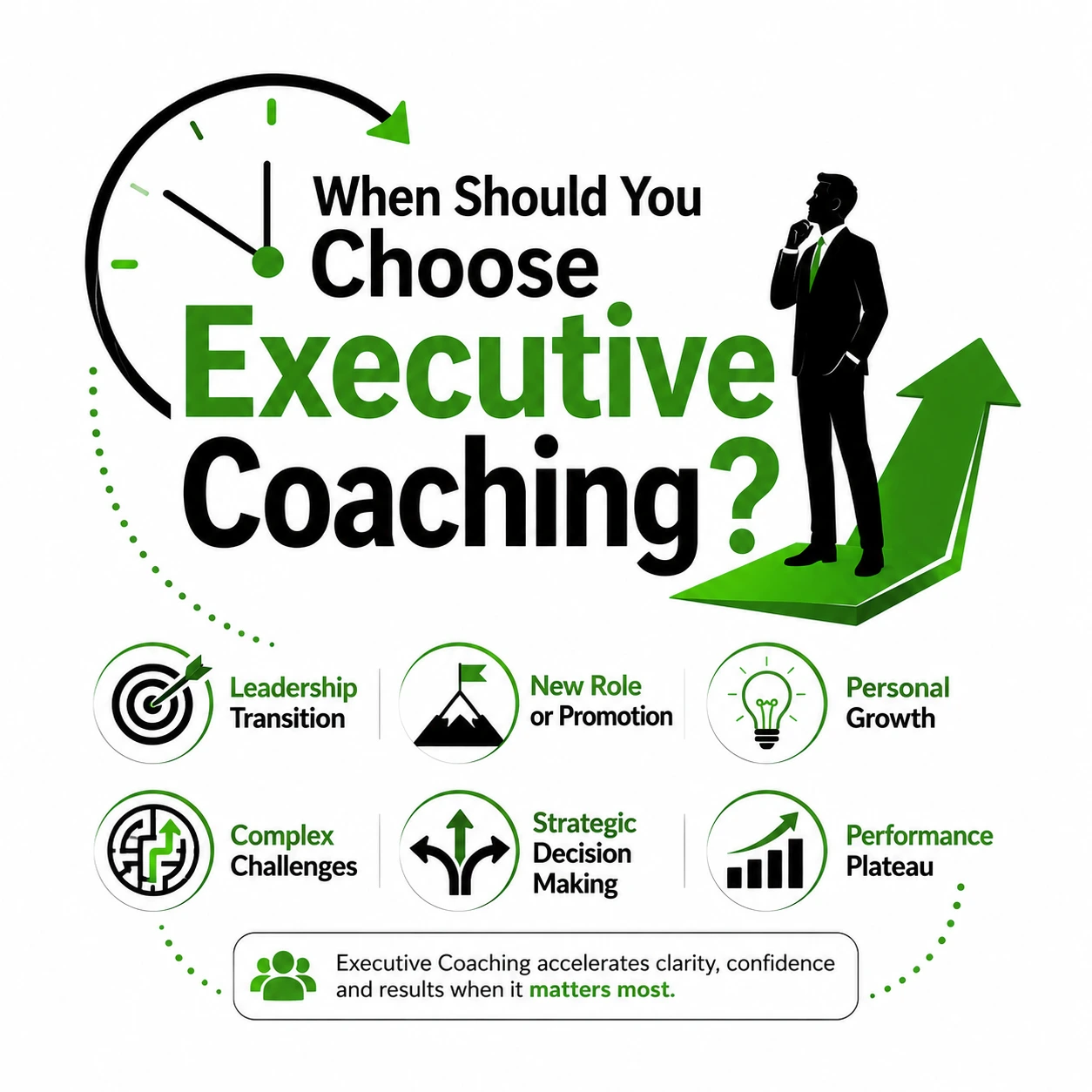
Executive coaching can be a powerful alternative if it’s about how you lead and not just what you need to know.
If you are thinking of executive coaching, consider the following:
-
- Difficulty in delegating effectively
-
- Need to enhance executive communication
-
- Want stronger leadership presence
-
- Receive tough feedback about your management style
-
- Are moving into a larger leadership role
-
- Need greater self-awareness
-
- Have reoccurring leadership difficulties
-
- Want to improve decision-making
-
- Need responsibility for a certain leadership goal
-
- Are undergoing a substantial organizational change;
For example, imagine a senior executive who frequently takes over work from their team because they believe it will be faster. The trouble might not be a lack of management knowledge. The deeper issue could involve trust, control, expectations, or communication.
A coach can assist the executive assess the pattern, comprehend its repercussions, and establish a fresh strategy.
That’s where coaching can be especially helpful: the goal is not just to give the leader another directive. The purpose is to help the leader understand the behavior well enough to modify it.
When Should You Choose Mentoring?
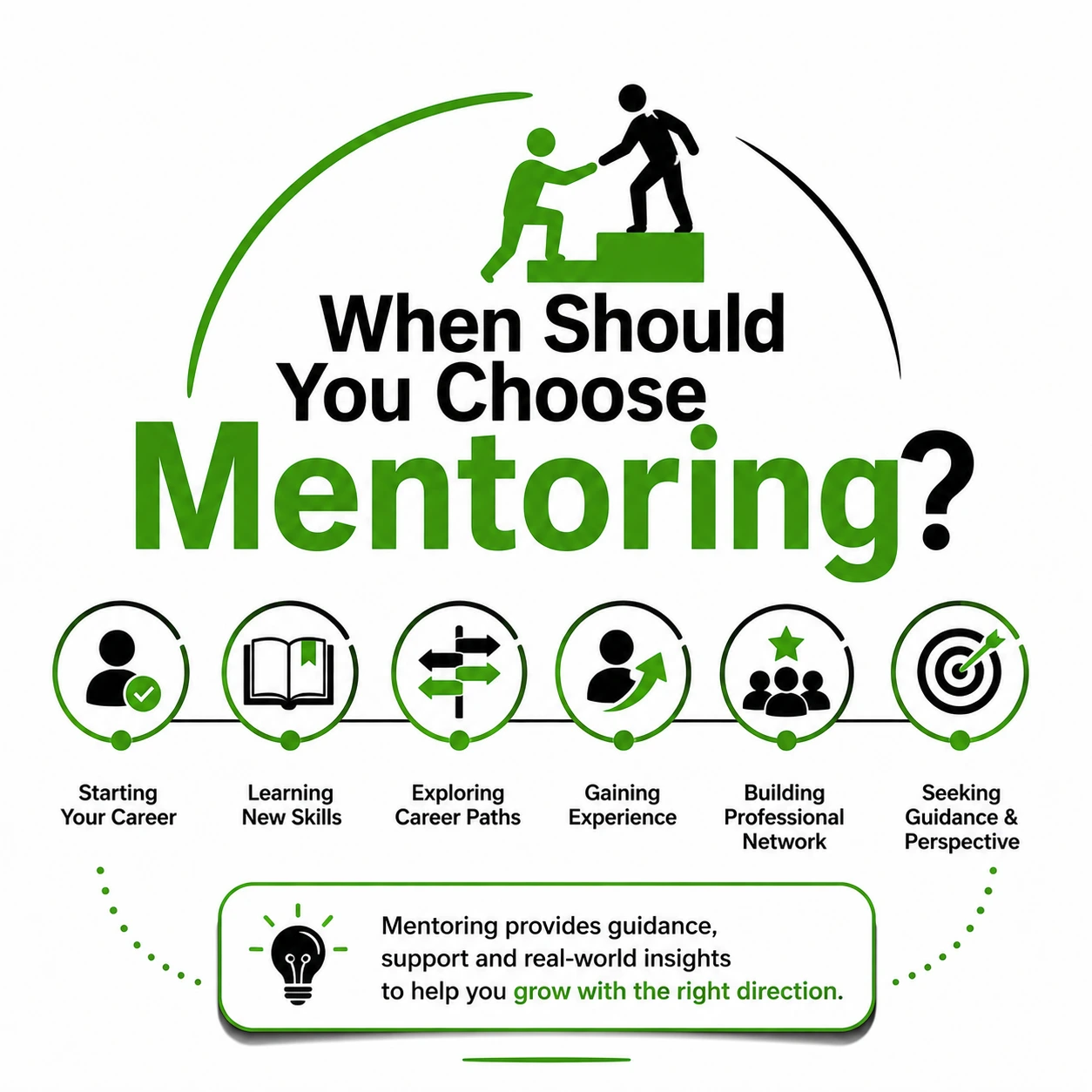
Mentoring might be more valuable when you need certain information, experience, or point of view.
A mentor may be helpful to you when you:
-
- Enter a new industry.
-
- Move into an unfamiliar executive position.
-
- Want advice from someone who has faced a similar challenge.
-
- Need industry-specific knowledge.
-
- Want to understand organizational politics.
-
- Need guidance about career progression.
-
- Want access to professional networks.
-
- Are building a business and need practical experience.
-
- Want to learn from someone who has already made similar decisions.
Say, a new Chief Marketing Officer would want a mentor who has already taken marketing teams thru mergers and acquisitions, worldwide expansion, or major reorganization.
The mentor can discuss what worked, what didn’t and what they would do differently.
That kind of direct experience can save time, and help the mentee avoid predicted mistakes.
Can Executive Coaching and Mentoring Work Together?
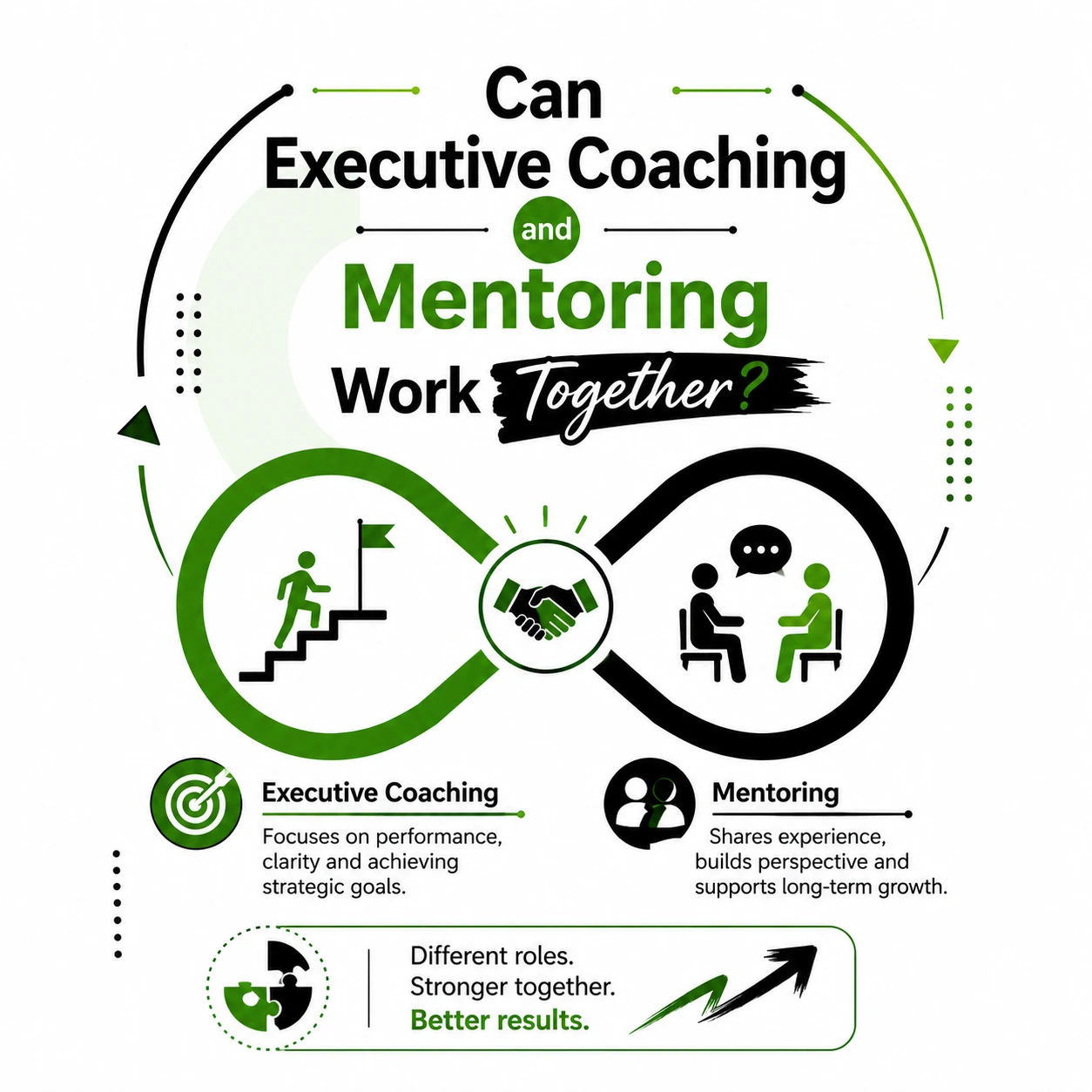
Yes. In reality, a mix of executive coaching and mentoring can be a more powerful leadership development technique.
Consider an executive who has recently become a CEO.
A mentor can provide insight into board interactions, investor expectations, organizational dynamics and frequent pitfalls of first-time CEOs.
An executive coach could help that same person examine their leadership behavior, manage pressure, communicate more effectively, and develop better decision-making habits.
The two relationships address different needs.
Mentoring can provide the map. Coaching can help the leader select how they wish to journey the route.
Organizations can therefore use coaching and mentoring as complementary parts of leadership development rather than treating them as competing solutions.
Executive Coaching vs. Mentoring for Leadership Development
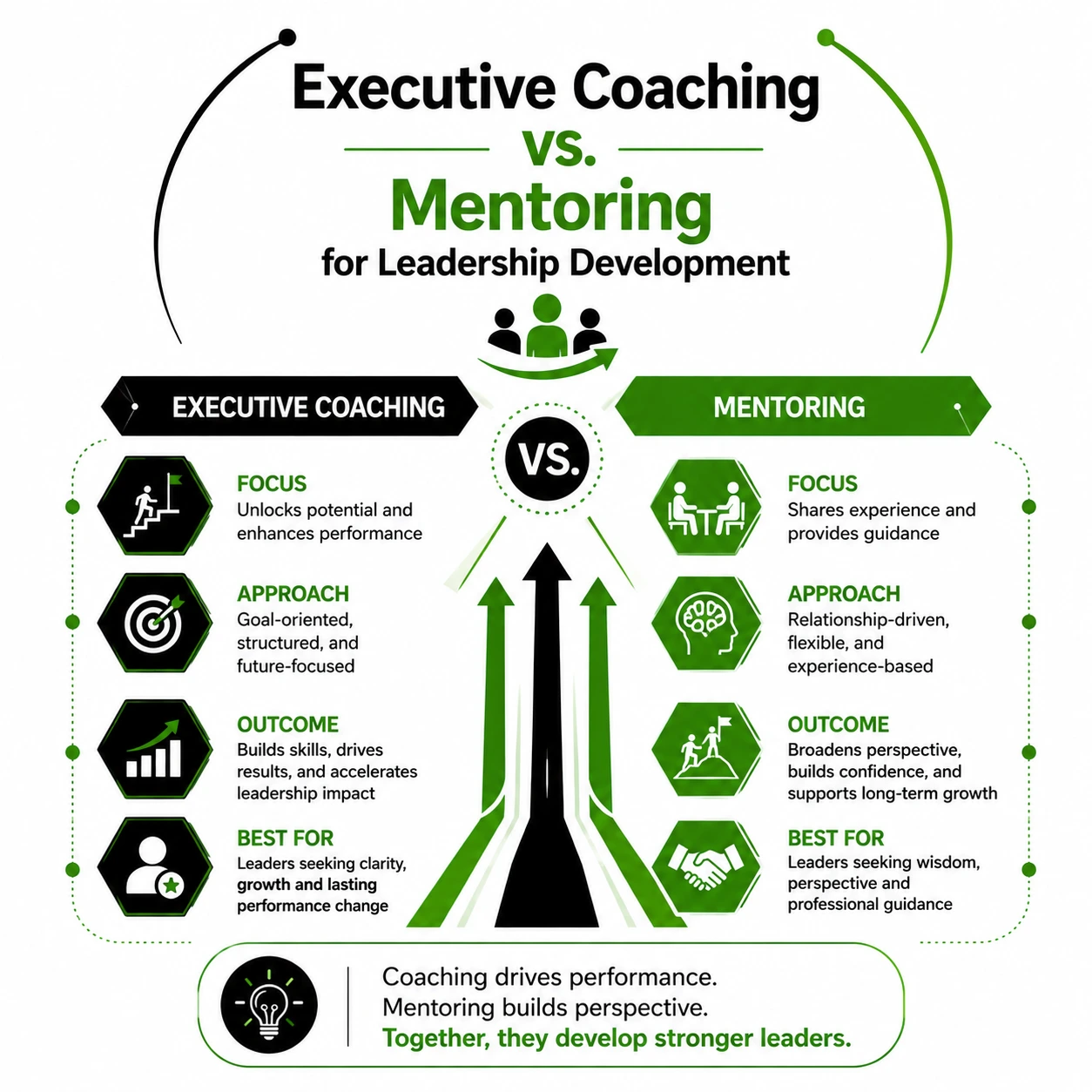
Leadership development is not always achieved thru training.
Delegation skills can be taught in a workshop. A mentor can tell you how delegation works at their organization. A coach can help a leader to understand why they have a hard time delegating personally and what needs to change.
This matters.
Leadership growth involves knowledge, conduct, judgment, self-awareness, and practice. Coaching and mentoring can support different aspects of that process.
» The Center for Creative Leadership advocates a deliberate use of coaching and mentoring in the development of new leaders and leadership pipelines.
If you want to know more about the bigger world of executive coaching, leadership development and professional coaching, see our comprehensive guide: The Complete Guide to Executive Coaching.
What Does the Coaching Industry Data Tell Us?

Coaching for professionals has become a big global business.
According to the International Coaching Federation’s 2023 Global Coaching Study, the expected number of professional coaches globally reached 109,200, reflecting a 54% growth between 2019 and 2022. The report also assessed global coaching sector income at $4.564 billion, a 60% increase compared with the prior survey.
These numbers are not to say that coaching creates outcomes with every leader. They show that professional coaching has developed into a significant field with growing demand.
For anyone considering executive coaching, credentials, methodology, experience, confidentiality, and the coach’s approach should weigh more than merely hiring someone with an impressive title.
How to Choose Between an Executive Coach and a Mentor
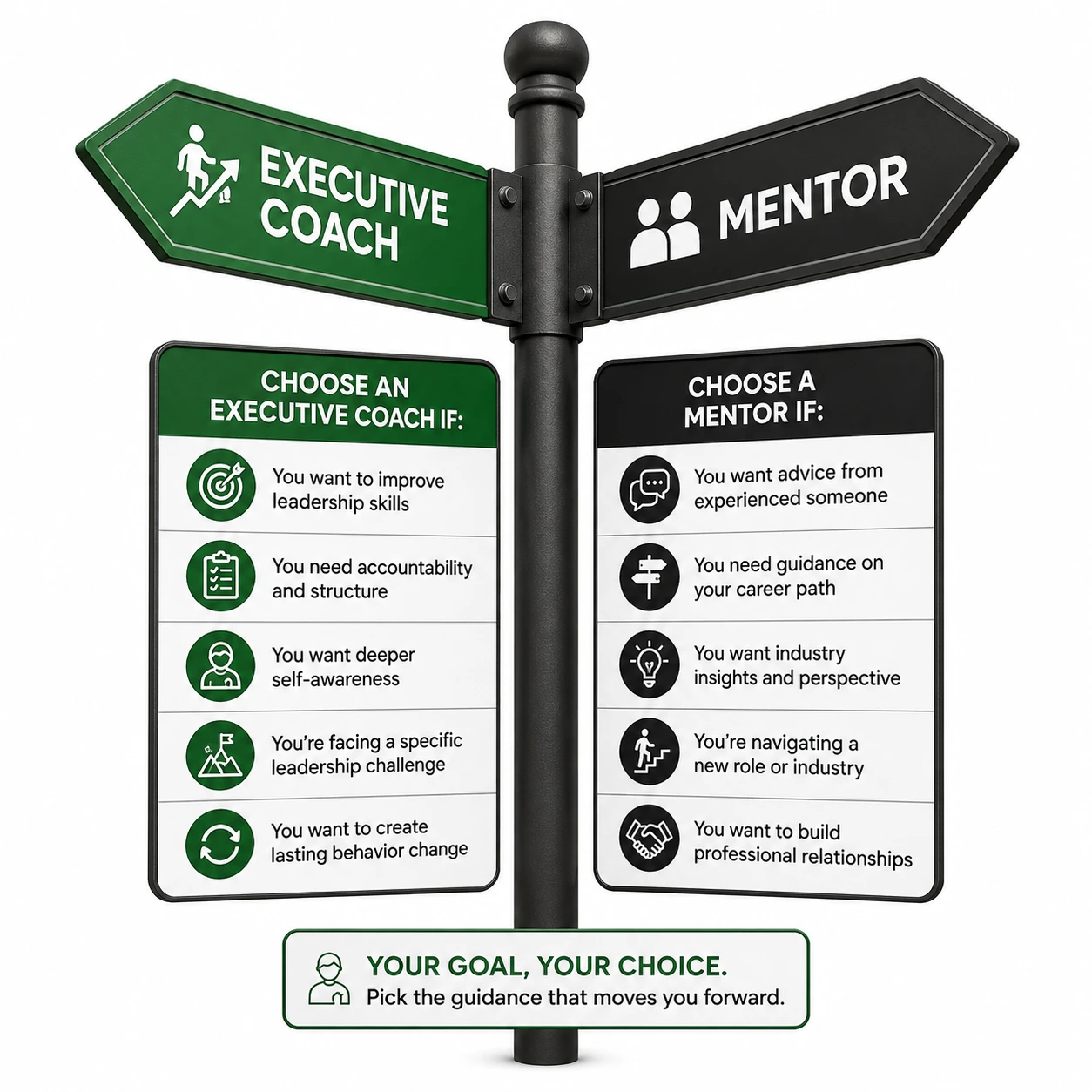
First, figure out what problem you want to solve.
If your question goes something like:
“HOW DO I BE A BETTER LEADER?”
Executive coaching may be appropriate.
If your question sounds like:
“How did you handle this situation when you were in my position?”
Mentoring may be the better fit.
You can also ask yourself four practical questions:
Do I need advice or deeper self-reflection?
Would industry experience or behavioral development help me more?
Am I looking for structured accountability?
Am I trying to fix a specific problem or build broader leadership capability?
Your answers will usually point toward the right option.
How to Find the Right Executive Coach
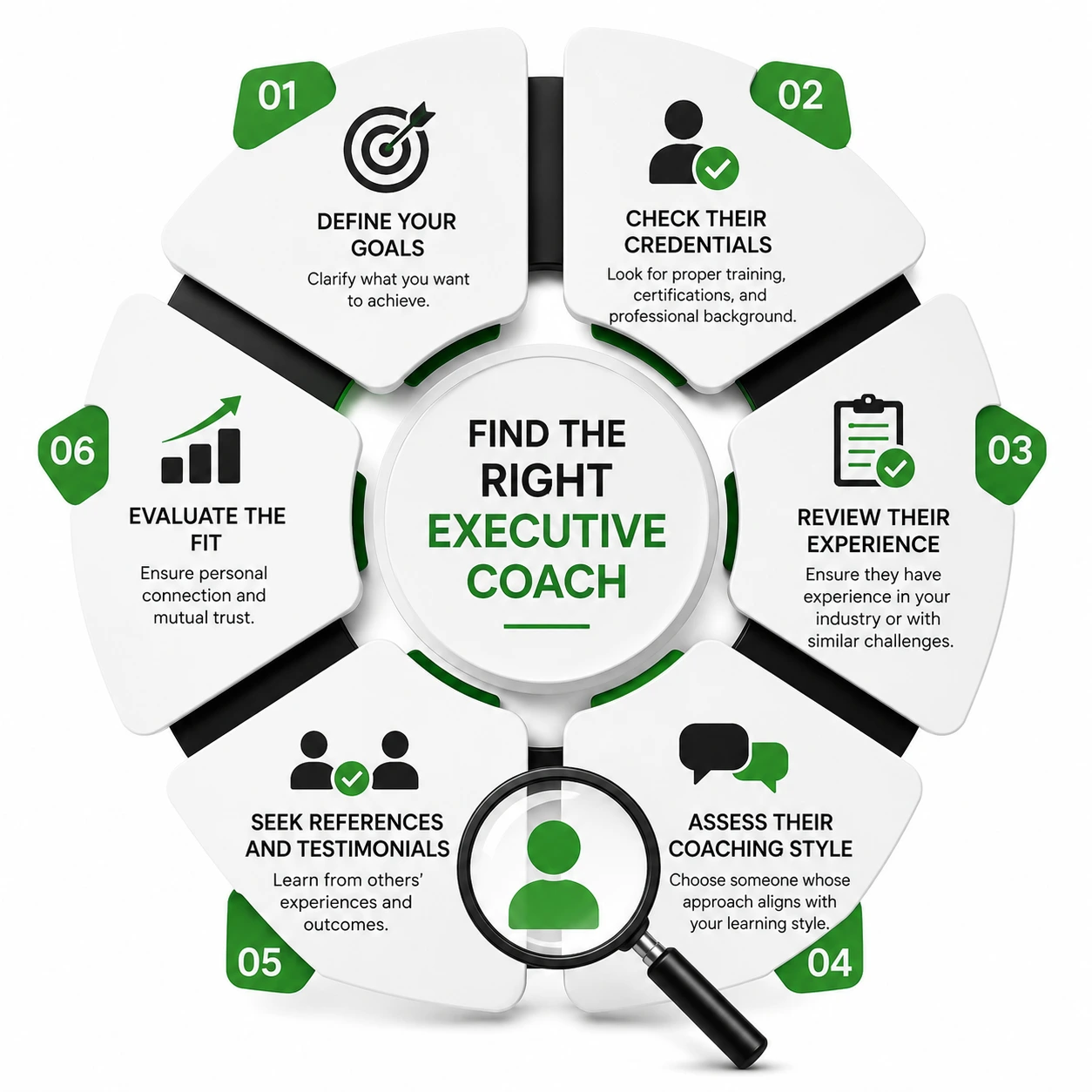
Choosing an executive coach requires more than checking credentials.
Look for someone who:
-
- Has a clear coaching methodology
-
- Understands executive-level challenges
-
- Establishes measurable goals
-
- Communicates expectations clearly
-
- Respects confidentiality
-
- Can challenge you without becoming judgmental
-
- Has relevant professional credentials or training
-
- Allows you to assess whether the relationship is a good fit
The coach should also understand that the client owns the development process.
A strong coaching relationship should not make the leader dependent on the coach. Instead, it should help the leader build greater awareness, confidence, responsibility, and decision-making ability.
Executive Coaching vs. Mentoring: Which One Is Right for You?
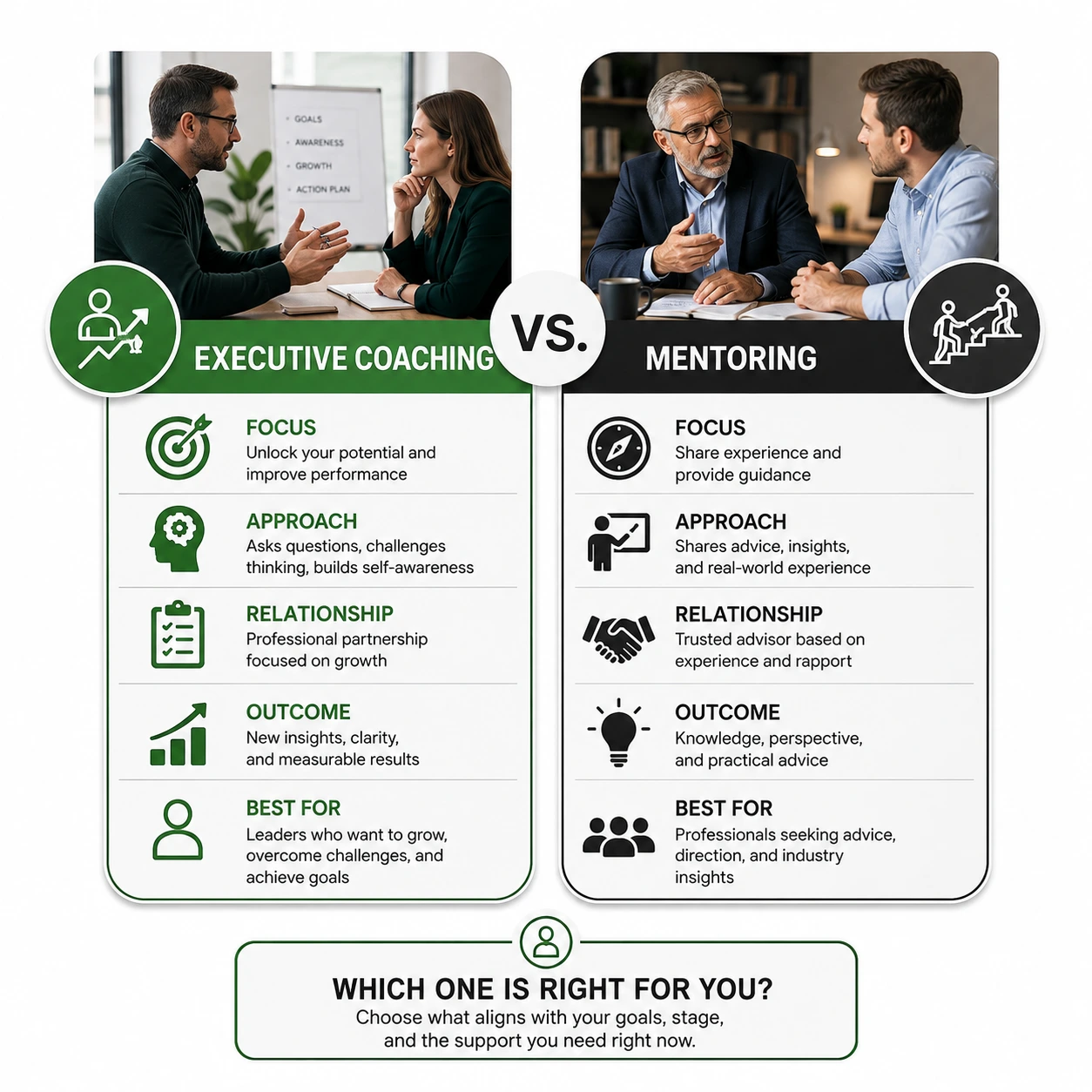
It is contingent upon what you need at this moment.
If you want to be better at thinking, leading, communicating, deciding or responding to issues, choose executive coaching.
Mentoring: select this if you want advice from someone who has already taken a similar career path.
Choose both when you need practical experience and deeper leadership development.
The most important point is not whether coaching or mentoring sounds more impressive. It’s about whether the method suits the problem you’re trying to address.
If you want organized support to improve leadership effectiveness, strengthen self-awareness, and turn leadership issues into quantifiable development goals, visit Executive Coaching Services and discover how the proper coaching relationship may support your next stage of growth.