

Does executive coaching work, or is it just an expensive conversation? It’s a fair question. Companies spend real money on it, and leaders give up real time. You deserve evidence, not sales talk.
This article looks at what the research says, where the data falls short, and what separates coaching that works from coaching that doesn’t.
The Short Answer: Yes, on Average, With Limits
Executive coaching works for most people who try it. The best studies show a moderate positive effect on leaders’ behavior, performance, and well-being. It is not a miracle fix, and results depend heavily on how the coaching is set up.
If you want the basics first, read our pillar guide: Executive Coaching: What It Is, How It Works, and Who It’s For.
What the Research Says About Executive Coaching?
Most coaching claims come from surveys of happy clients. That is weak evidence. The strongest evidence comes from randomized controlled trials (RCTs), where one group gets coaching and a similar group does not.
A Meta-Analysis of 37 Randomized Trials
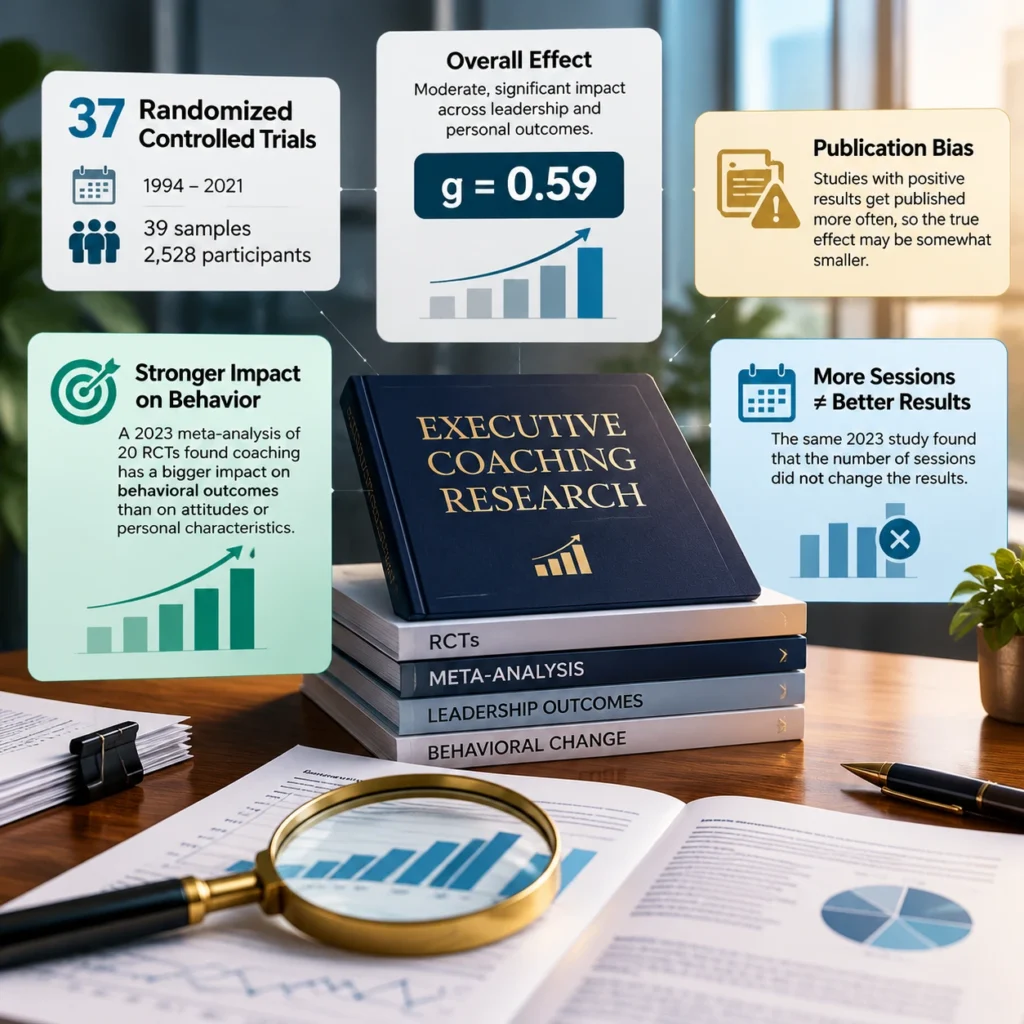
A meta-analysis of 37 RCTs covered workplace and executive coaching studies from 1994 to 2021. It pooled 39 samples with 2,528 participants. The researchers found a statistically significant effect across leadership and personal outcomes. Their best estimate was a moderate effect (g = 0.59).
They also warned about publication bias. Studies with positive results get published more often than studies with weak ones. So the true effect may be somewhat smaller.
Coaching Changes Behavior Most
A 2023 meta-analysis in Frontiers in Psychology analyzed 20 RCTs. It found that coaching had a bigger impact on behavioral outcomes than on attitudes or personal characteristics. In plain terms, coaching changes what leaders do more than how they feel about it.
The same study found that the number of sessions did not change the results. More sessions do not automatically mean better outcomes.
Earlier Evidence Points the Same Way
An earlier 2017 meta-analysis of 11 RCTs looked at performance, well-being, coping, work attitudes, and goal-directed self-regulation. It found a moderate, significant positive effect (0.42). Different teams, different studies, and the same direction.
| Study | Trials included | Main finding |
|---|---|---|
| 2017 meta-analysis (Burt & Talati) | 11 RCTs | Moderate positive effect (0.42) |
| 2023 meta-analysis (Nicolau et al.) | 20 RCTs | Strongest effect on behavior; session count did not matter |
| Meta-analysis of 1994–2021 studies | 37 RCTs, 2,528 participants | Moderate effect (g = 0.59), with signs of publication bias |
Where the Data Has Limits?
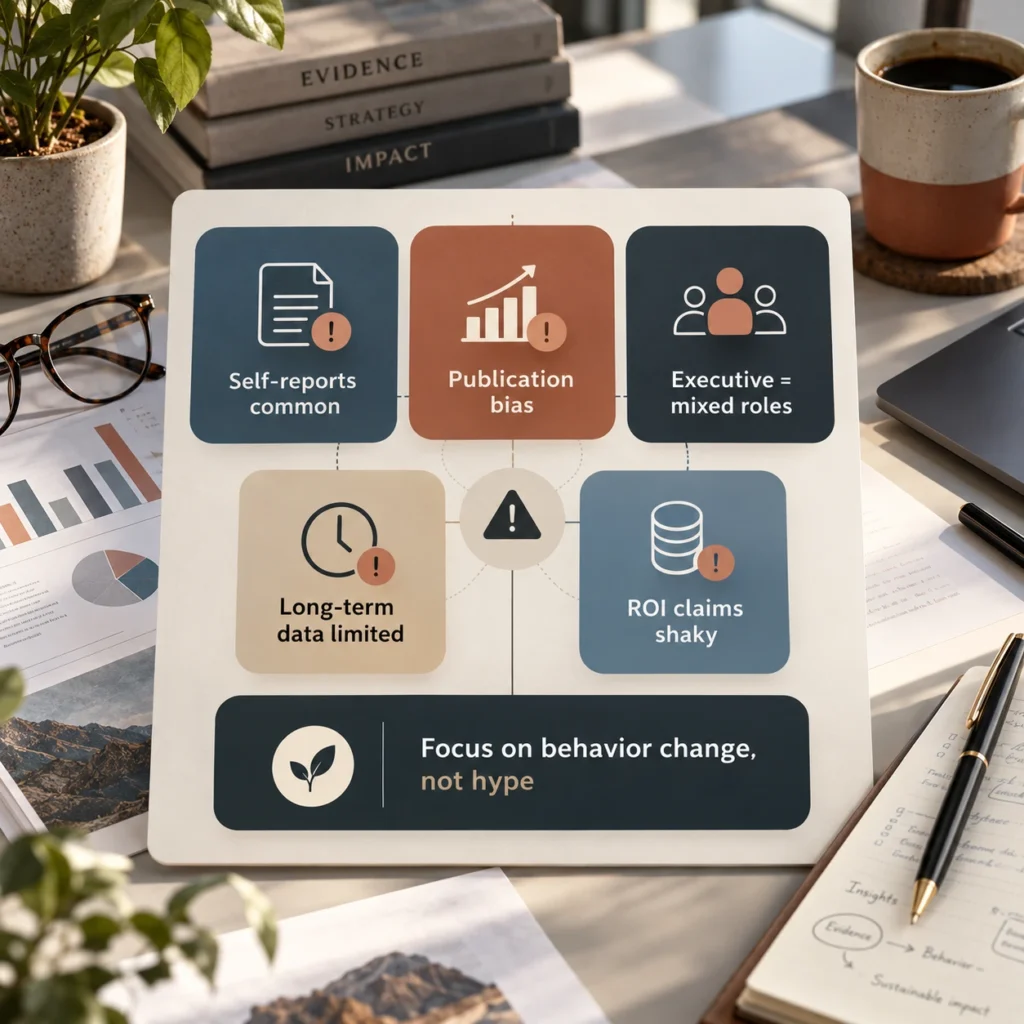
Good evidence still has gaps. Be careful with these:
- Most studies measure self-reports. Leaders often rate their own progress.
- Publication bias is real. Positive studies reach print more often.
- “Executive” means different things. Study participants range from senior managers to mid-level leaders.
- Few studies track long-term results. We know less about what happens years later.
- Dollar ROI claims are shaky. Many famous return-on-investment numbers come from small or unpublished studies. Treat them with caution.
That last point matters. Be skeptical when anyone promises “7x ROI” without naming a source. Honest providers talk about behavior change and clear goals instead.
What Executive Coaching Actually Improves?
The research measures real workplace outcomes. These include:
- Performance: Hitting goals and delivering results
- Well-being and coping: Handling stress and pressure
- Work attitudes: Engagement and commitment
- Goal-directed behavior: Setting a plan and following through
In practice, leaders often work on giving direct feedback, delegating, making faster decisions, and managing difficult people.
What Makes Coaching Work? (and What Makes It Fail)
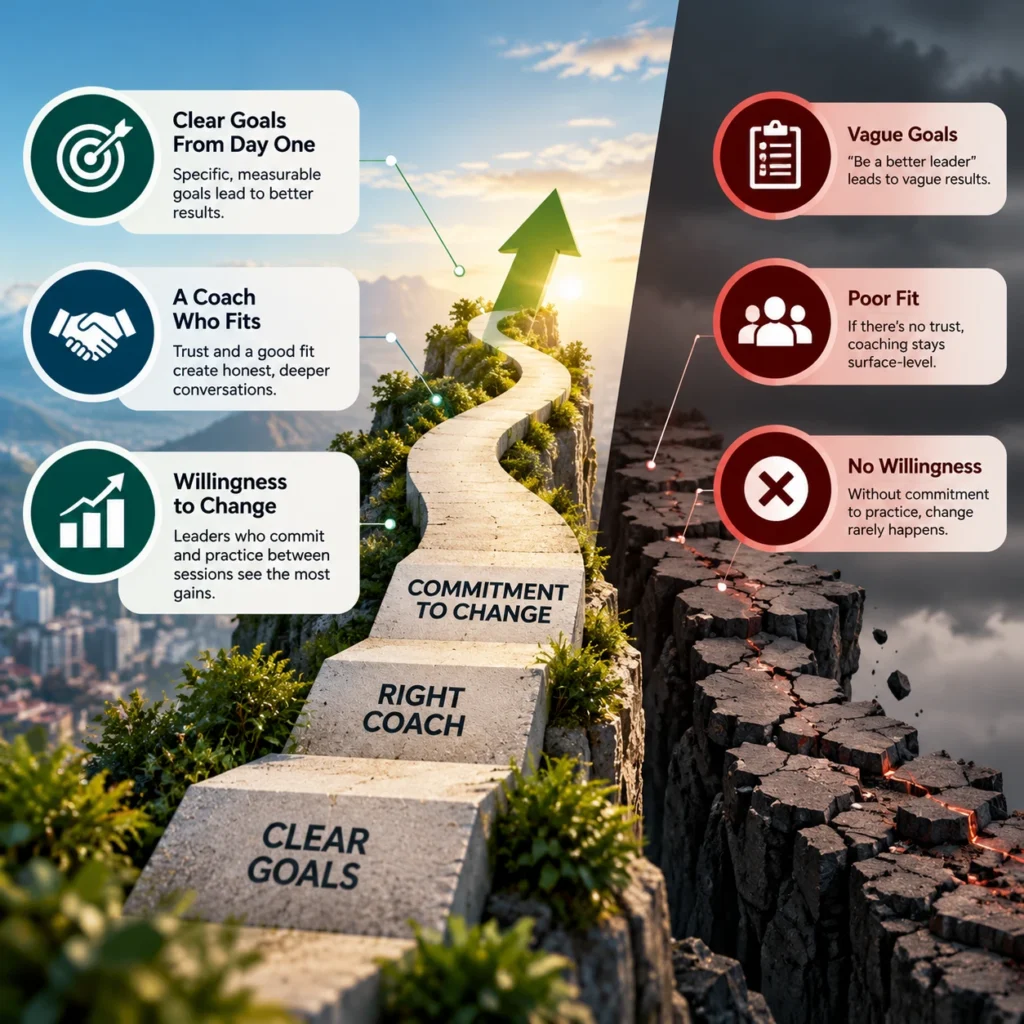
Coaching is not magic. Three factors decide most outcomes.
Clear Goals From Day One
The 2025 ICF Global Coaching Study states that coaching works when organizations define and track success. Vague goals like “be a better leader” lead to vague results. Specific goals work better. For example: “hold weekly one-on-ones and cut my meeting load by a third.”
A Coach Who Fits
Trust drives everything. If a leader does not feel safe being honest, the coaching stays surface-level. A good fit matters more than a famous name.
Willingness to Change
Coaching cannot work on someone who does not want it. Leaders who volunteer and commit to practicing between sessions get the most out of it.
Is Executive Coaching Worth It?

It is worth it when you pick the right leaders, set clear goals, and measure progress. The coaching industry’s growth hints at demand. The ICF study reports $5.34 billion in global annual revenue, a 17% rise since 2023.
Demand alone does not prove value. But it shows that organizations keep paying for it.
Coaching tends to pay off most for:
- Newly promoted managers moving into bigger roles
- Senior leaders who lack honest feedback
- Leaders facing a major change, such as a merger or turnaround
- High-potential employees preparing for senior roles
How to Get Real Results From Coaching?
- Set two or three measurable goals before the first session.
- Choose a trained coach with a recognized credential and a clear process.
- Gather feedback from colleagues at the start and again after several months.
- Review progress every month, not just at the end.
- Practice between sessions. Real change happens at work, not in the session.
Our Leadership Coaching Services follow this approach and match each program to the leader’s role and goals.
Conclusion: So, Does Executive Coaching Actually Work?
Does executive coaching actually work? The data says yes, with a moderate effect, strongest on behavior. It works best with clear goals, a good coach match, and a leader who wants to grow. It does not work as a quick fix, and honest providers will tell you that.
Ready to see what coaching could do for you or your team? Explore our Leadership Coaching Services, book a discovery call, and share your biggest leadership challenge. You will leave with a clear first step.